
Types of crystals: a color-by-color guide with names and a chart
Find your crystal by color, compare hardness and look-alikes in one chart, and see which stones can't handle water or sunlight before you clean them.


Tap to add a photo, or drop one here
JPG, PNG, WebP, HEIC • Max 50 MB • 1 free scan a day

Analyzing your specimen…
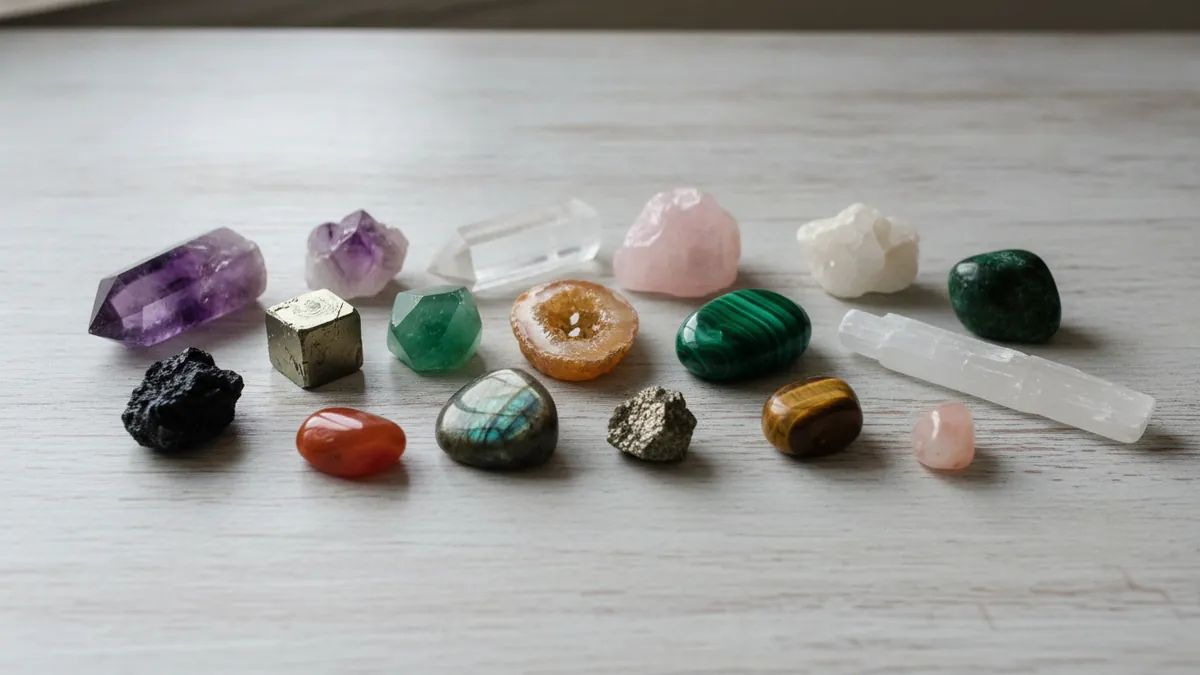
What are the main types of crystals?
The crystals most people own come from a short list. Quartz covers a big share of it: clear quartz, amethyst, citrine, rose quartz, smoky quartz and the chalcedony family (agate, carnelian, jasper). After quartz come the feldspars, such as moonstone, labradorite and amazonite, plus fluorite, calcite, selenite, pyrite, tourmaline, garnet, malachite, lapis lazuli and turquoise. Color narrows the list. Hardness and luster confirm it.
A few stones below aren't crystals in the strict sense. Obsidian is volcanic glass, and lapis lazuli is a rock made of several minerals. Shops sell them next to amethyst anyway, so they're here too. The mineral vs rock vs crystal explainer sorts out the difference.
Geologists also use "crystal types" for the seven crystal systems, which describe internal symmetry. Pyrite, fluorite and garnet are cubic; quartz and calcite are trigonal; gypsum is monoclinic. That system helps with sharp, well-formed crystals. Most tumbled stones have no faces left to read, so this page sorts by color.
Crystal chart: 33 common crystals by color
Rows run from clear and white through purple, pink, red, gold, green and blue, then black. Hardness is on the Mohs scale, where window glass and a steel knife blade both sit around 5.5. The last column is what each stone gets confused with most, sometimes another mineral, sometimes glass or a dyed fake.
| Name | Color | Hardness (Mohs) | How to recognize it | Common look-alike |
|---|---|---|---|---|
| Clear quartz | Colorless | 7 | Six-sided points, glassy, scratches glass | Glass, calcite |
| Selenite | White, colorless | 2 | Silky fibrous sheen; a fingernail scratches it | Satin spar calcite |
| Calcite | White, honey, orange, green, blue | 3 | Breaks into slanted box shapes (rhombs); fizzes in dilute acid | Quartz, fluorite |
| Apophyllite | Colorless, pale green | 4.5 to 5 | Square pyramids with a pearly base | Clear quartz |
| Howlite | White with gray veins | 3 to 3.5 | Chalky white with spiderweb veining | Magnesite |
| Moonstone | White, peach, gray | 6 to 6.5 | Blue or white glow gliding under the surface | Opalite glass |
| Amethyst | Purple | 7 | Purple quartz, often darker at the tips | Purple fluorite, glass |
| Fluorite | Purple, green, banded | 4 | Cubes or octahedra, color stripes, marked by steel | Amethyst |
| Rose quartz | Pale pink | 7 | Milky translucent pink, almost always massive | Dyed quartz, pink glass |
| Rhodochrosite | Pink to red | 3.5 to 4 | Pink with white zigzag bands | Rhodonite |
| Rhodonite | Pink with black veins | 5.5 to 6.5 | Opaque pink with black veining | Rhodochrosite |
| Garnet | Dark wine red | 6.5 to 7.5 | Ball-shaped crystals with many diamond-shaped faces | Ruby, red glass |
| Carnelian | Orange to red | 6.5 to 7 | Waxy luster; glows orange when backlit | Dyed agate, red jasper |
| Red jasper | Brick red | 6.5 to 7 | Fully opaque, no light through the edges | Carnelian |
| Citrine | Pale yellow to orange-brown | 7 | Natural is pale champagne; deep orange tips on a white base are heated | Heated amethyst, yellow glass |
| Sunstone | Orange, peach | 6 to 6.5 | Coppery glitter from tiny platelets inside | Goldstone (glass) |
| Pyrite | Brassy yellow | 6 to 6.5 | Cubes, heavy, greenish-black streak | Gold, chalcopyrite |
| Tiger's eye | Golden brown | 6.5 to 7 | Silky band of light that rolls as you tilt it | Fiber-optic glass |
| Green aventurine | Green | 6.5 to 7 | Fine glitter from green mica flecks | Jade, dyed quartzite |
| Malachite | Banded green | 3.5 to 4 | Concentric light and dark green rings | Resin imitations |
| Jade | Green, white, lavender | 6 to 7 | Even waxy glow, cool, very tough | Serpentine, aventurine |
| Moss agate | Clear with green | 6.5 to 7 | Green moss-like growths in translucent stone | Dendritic agate |
| Amazonite | Blue-green | 6 to 6.5 | Opaque teal with white streaks | Turquoise, chrysoprase |
| Lapis lazuli | Deep blue | 5 to 5.5 | Blue with gold pyrite flecks and white patches | Sodalite, dyed howlite |
| Sodalite | Royal blue and white | 5.5 to 6 | Blue with white veins, no gold | Lapis lazuli |
| Turquoise | Sky blue to green | 5 to 6 | Opaque, often with a brown or black matrix web | Dyed howlite, dyed magnesite |
| Blue lace agate | Pale blue banded | 6.5 to 7 | Lacy bands of pale blue and white | Dyed agate |
| Celestite | Pale blue | 3 to 3.5 | Bladed crystals in geodes, heavy for the size | Blue barite |
| Labradorite | Gray | 6 to 6.5 | Blue, gold or green flash at one angle | Moonstone |
| Smoky quartz | Brown to near black | 7 | Transparent brown quartz points | Irradiated quartz, obsidian |
| Black tourmaline | Black | 7 to 7.5 | Grooved prisms with a rounded-triangle end | Hornblende |
| Obsidian | Black, glassy | 5 to 5.5 | Shell-shaped fractures, sharp edges, no faces | Black glass, slag |
| Hematite | Silver-gray to black | 5.5 to 6.5 | Heavy, metallic, red-brown streak | Hematine (man-made, magnetic) |
Clear and white crystals
For a clear point, guess quartz first. You'll usually be right. Drag it across a glass bottle: quartz bites in and leaves a scratch, while calcite and apophyllite skid. Calcite turns up in half the colors on this page, but it always breaks into slanted box shapes, and a clear piece set on printed text shows the letters doubled.
- Clear quartz is fine with soap and water. A hot windowsill followed by a cold rinse can crack a point, though.
- Selenite should stay dry. It's gypsum, which dissolves slowly in water, and the silky fibers fray once wet. Clean it with a dry paintbrush.
- Calcite etches in vinegar or lemon juice. A damp cloth is all it needs.
- Apophyllite splits easily along its base, so pick up clusters by the rock they sit on.
- Howlite is porous enough that sellers dye it blue to imitate turquoise. Wipe it; don't soak it.
- Moonstone has two cleavage directions and can split on a tile floor. Store it away from harder stones.
Purple and pink: amethyst, fluorite and the rhodo- pair
Amethyst and fluorite get mixed up more than any other purple pair, and hardness settles it. Amethyst is 7. Fluorite is 4, so a steel knife tip leaves a mark on it and slides off amethyst. Test on the back or a broken edge, never the best face. Fluorite also tends to show stripes of purple, green and clear in one piece. The Mohs hardness guide walks through the scratch test.
Rose quartz almost never grows as points; nearly all of it is massive, milky pink chunks. Rhodochrosite and rhodonite share a Greek root (rhodon, rose) and a color. Look for white zigzag bands (rhodochrosite) or black veins (rhodonite). That one detail is usually enough.
Sunlight is the real enemy in this group. Amethyst, rose quartz and fluorite can pale after months on a bright windowsill. Fluorite also chips at the slightest knock. Rhodochrosite is soft and dissolves in acid, so no vinegar and no ultrasonic cleaner; rhodonite is tougher and takes a rinse.
Red, orange and gold crystals
Is my citrine real?
Most bright citrine in shops is heat-treated amethyst. You'll know the look: dark orange or burnt-yellow tips on a chalky white base, usually a cluster broken out of a geode. Natural citrine is paler, closer to champagne. Both are quartz. The price should reflect which one you have.
Carnelian, jasper and garnet
Hold a red stone up to a lamp. Carnelian glows orange at the edges; red jasper stays dark. Garnet is the wine-red one, and raw garnets look like small balls covered in diamond-shaped faces.
Pyrite, sunstone and tiger's eye
Pyrite forms brassy cubes, sometimes so square they look machined, and streaks greenish-black on unglazed porcelain. Gold streaks gold and dents under a pin; the pyrite vs gold guide covers the rest. Sunstone sparkles from copper or hematite platelets scattered unevenly inside, while goldstone (its glass imitation) has suspiciously even sparkles. Tiger's eye has a band of light that rolls as you turn it.
Garnet, carnelian, jasper and tiger's eye shrug off water. Pyrite doesn't. In humid air it can grow a whitish powdery crust and slowly crumble, so keep it dry.
Green crystals
Green is where mislabeled stones pile up. Green aventurine gets sold as "jade" often enough that a quick check is worth it: tilt it under a light. Aventurine glitters from flecks of a green mica called fuchsite; jade has an even, waxy glow with no sparkle at all. Malachite is the easy one, with light and dark green rings like a cut tree trunk. Resin fakes tend to have rings that are too regular, and they feel warm and light in the hand.
Amazonite is opaque blue-green feldspar with white streaks. Moss agate looks like moss frozen under ice.
- Malachite is a copper mineral. Polished pieces are fine to handle, but never cut or sand it dry, since the dust is toxic. Water and acids dull the polish.
- Amazonite cleaves easily and can chip if dropped on stone.
- Jade is one of the toughest stones on this list and handles water.
- Aventurine and moss agate are quartz and need nothing special.
How do you tell blue crystals apart?
Start with lapis lazuli and sodalite, the pair that causes the most confusion. Lapis has gold pyrite flecks and often white calcite patches. Sodalite is a cooler royal blue with white veins and almost never shows gold. A uniform, very bright blue on a cheap stone? Probably dyed howlite.
Turquoise is opaque sky blue to green, often crossed by a dark matrix web. Blue lace agate has soft pale bands. Celestite usually comes as a geode lined with pale blue blades, and it feels heavier than it looks.
Turquoise is porous; skin oil, lotion and perfume can push it toward green over the years. Wipe it after wearing. Lapis is also better wiped than soaked. Celestite fades in sunlight and its blades snap easily, so it belongs in a cabinet, dusted with a soft brush.
Black, gray and brown crystals
Black tourmaline grows as long prisms with grooves running lengthwise; look at the end and the outline is a rounded triangle. Obsidian has no crystal faces. It's glass, with curved shell-like fractures and edges sharp enough to cut you. Smoky quartz is see-through brown quartz, and points that are evenly jet black are often irradiated clear quartz.
Labradorite looks like a dull gray rock until you turn it and a flash of blue or gold jumps across the surface. Hematite is heavy and metallic with a red-brown streak. Those shiny beads that snap onto a magnet are usually hematine, which is man-made; real hematite is at most weakly magnetic.
Care is mostly about knocks. Obsidian chips, long tourmaline crystals snap across the prism, and labradorite splits along cleavage like moonstone. Hematite can rust on the surface if left wet.
Types of quartz crystals in one table
Eleven of the 33 stones above are made of quartz. Some grow as visible crystals. The chalcedony family is quartz too, in grains too small to see.
| Variety | Where the color comes from | How it usually grows |
|---|---|---|
| Clear quartz | No coloring agent | Six-sided points and clusters |
| Amethyst | Iron plus natural radiation | Points, often lining geodes |
| Citrine | Iron, or heat applied to amethyst | Points and geode clusters |
| Rose quartz | Microscopic mineral fibers | Massive, rarely as points |
| Smoky quartz | Natural radiation acting on aluminum | Points, sometimes very large |
| Chalcedony (agate, carnelian, jasper) | Iron oxides and other impurities | Bands or solid masses of tiny grains |
For prasiolite, lemon quartz and the rest, see how to identify quartz varieties.
When your crystal isn't in the chart
These 33 cover most shop shelves. Beaches, road cuts and a grandparent's junk drawer turn up stranger things. The scanner at the top of this page is the quickest check: photograph the crystal in daylight on a plain background, with its most typical face toward the lens. Dyed stones are the other trap, and how to tell if a crystal is real covers giveaways like color pooling in cracks. If color is all you have, identifying crystals by color goes further than this page.
On iPhone, AI Rock ID is a crystal identifier that names a specimen from one photo, out of 6,000+ crystals, rocks, minerals, gems and fossils. It gives a confidence score, the look-alikes with how to tell them apart, hardness, streak and a value range (an estimate, not an appraisal).
On Android, the same crystal identifier app saves finds to a collection and has an AI chat for follow-ups like "will this fade on my windowsill?" No account needed. Scans are free every day; PRO removes the limit.
Frequently asked questions
What are the most common types of crystals?
Clear quartz, amethyst, rose quartz, citrine, smoky quartz and agate are the ones most people own, and all of them are quartz. Outside quartz, fluorite, calcite, selenite, pyrite and black tourmaline show up in nearly every crystal shop.
How many types of crystals are there?
Mineralogists recognize more than 6,000 mineral species, and most of them can form crystals. Crystal shapes fall into seven crystal systems, such as cubic for pyrite and trigonal for quartz.
Can you identify a crystal by color alone?
Color narrows it down but rarely proves it, because quartz, calcite and fluorite each come in many colors and dyed stones are common. Check hardness, luster and crystal shape next.
Which crystals should not go in water?
Selenite, celestite, malachite, pyrite, turquoise and hematite should be kept dry or only wiped with a damp cloth. Calcite and rhodochrosite survive a quick wipe but are damaged by acids like vinegar.
Which crystals fade in the sun?
Amethyst, rose quartz, fluorite and celestite can lose color after long exposure to direct sunlight. Display them away from bright windows.
Is obsidian a crystal?
No, obsidian is volcanic glass and has no crystal structure. It is sold alongside crystals and is fine to collect, it just isn't a mineral.
How do I tell amethyst from purple fluorite?
Amethyst has a hardness of 7, so a steel knife slides off it, while fluorite is 4 and takes a scratch. Fluorite also tends to show bands of purple, green and clear and breaks along flat cleavage faces.
Why does my hematite stick to a magnet?
Beads that snap strongly to a magnet are usually hematine, a man-made material sold as hematite. Natural hematite is at most weakly magnetic and leaves a red-brown streak.