
How to identify a meteorite
Run your rock through six home tests, compare it with the common look-alikes, and find out where to send it if it still passes.


Tap to add a photo, or drop one here
JPG, PNG, WebP, HEIC • Max 50 MB • 1 free scan a day

Analyzing your specimen…
How do you tell if a rock is a meteorite?
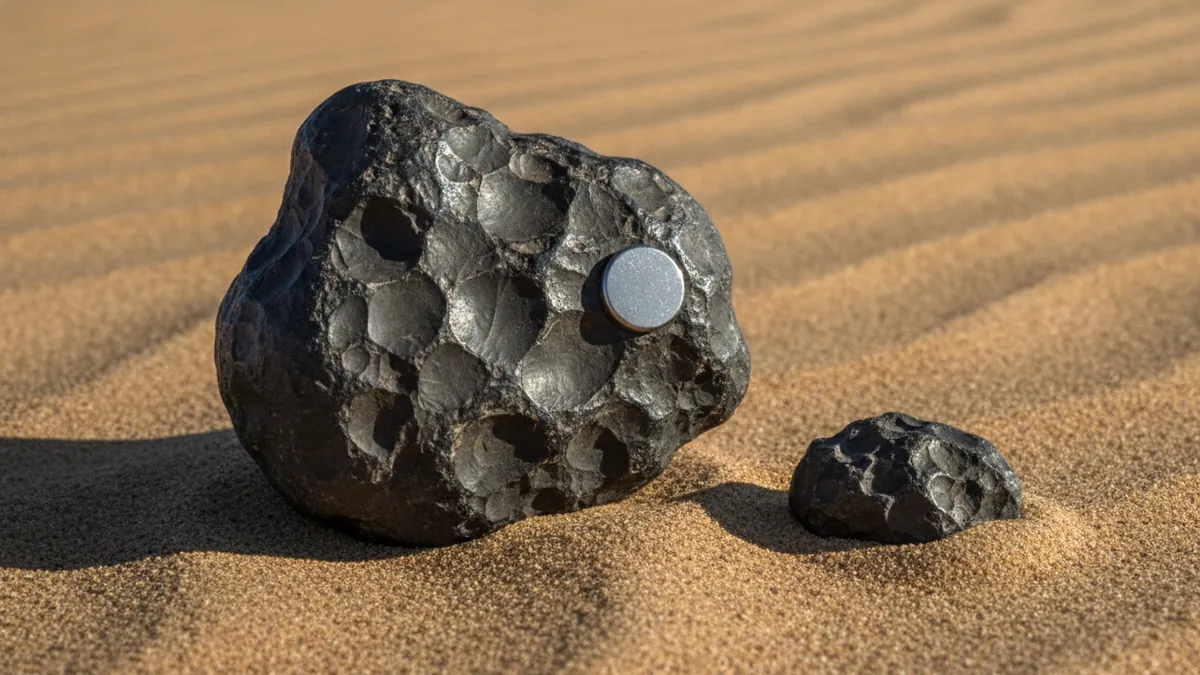
A meteorite is usually heavier than it looks, pulls on a magnet, leaves little or no streak on unglazed porcelain, and has a thin black or brown fusion crust, sometimes dented with thumbprint-like regmaglypts. It has no gas bubbles and no layers. A rock that fails two or more of these tests is almost certainly from Earth; one that passes them all is worth showing to a lab.
Most of that list needs only a magnet and a bathroom tile. The harder part is being strict with yourself. Earth makes plenty of heavy black rocks that stick to magnets, and university labs that look at samples from the public, such as the one at Washington University in St. Louis, report that most of what people send them is ordinary terrestrial rock.
It helps to know which kind of meteorite you might have, because the main groups give different results on the same tests. Chondrites, a type of stony meteorite, are the most common kind that falls.
| Type | What it is | Density (g/cm3) | Magnet | What you see |
|---|---|---|---|---|
| Iron | Mostly iron-nickel metal | About 7.5 to 8 | Strong pull | Dense metal mass, often with regmaglypts, rusts brown |
| Stony (ordinary chondrite) | Silicate minerals with metal grains and chondrules | About 3.3 to 3.7 | Usually attracts | Gray interior with shiny metal flecks and small round grains |
| Stony (achondrite) | Melted and recrystallized rock with little metal | About 3.0 to 3.3 | Weak or none | Can look a lot like basalt; the hardest group to spot at home |
| Stony-iron | Metal mixed with silicate minerals | About 4.3 to 4.9 | Strong | Metal network around stony pieces (pallasites hold olivine crystals) |
| Ordinary Earth rock, for comparison | Granite, sandstone, basalt | About 2.5 to 3.0 | Usually none | No metal flecks; often visible grains, layers or holes |
The meteorite test checklist
Gather a strong magnet (a small neodymium magnet on a string is ideal), an unglazed ceramic tile, a kitchen scale and a hand lens. Then work through the tests in this order, from the surface inward.
| Test | How to do it | Meteorite result | Red flag |
|---|---|---|---|
| 1. Fusion crust | Look over every side in daylight | Thin black or brown skin, about 1 mm or less, sometimes with flow lines | Thick crumbly rind, or the same texture all the way through |
| 2. Regmaglypts | Run your thumb over the surface | Shallow, smooth dents like thumbprints in clay | Sharp-rimmed pits or round holes |
| 3. Magnet | Dangle a magnet on a string near the rock | Most meteorites pull the magnet noticeably | No pull at all |
| 4. Weight | Compare with a granite cobble of the same size, or measure density | Clearly heavier than common rock | Feels like any other rock its size |
| 5. Streak | Scrape a fresh corner across unglazed porcelain | No streak or a faint gray line | Red-brown or black streak |
| 6. Holes and layers | Check the surface and a small ground window | Solid stone or metal, no bubbles, no banding | Gas bubbles, sponge texture, stripes or layers |
Score it honestly. One weak result isn't fatal, since a weathered stone can lose its crust and a rare achondrite may ignore your magnet. Three or four red flags, though, and you're holding a meteor-wrong.
Reading the outside: fusion crust and regmaglypts
As a meteoroid falls, the air in front of it heats the surface until the outer layer melts, and that melt hardens into a glassy skin once the rock slows down. This skin is the fusion crust. On a fresh fall it is black and thin, usually around a millimeter or less, and it looks a bit like matte paint over the stone. Years on the ground turn it brown or rusty, and some old finds have lost most of it. Fine ridges running in one direction (flow lines) are a good sign; they form where melt streamed backward across the leading face.
Regmaglypts are smooth, shallow dents that look like thumbprints pressed into soft clay. Iron meteorites show them most often. Stony meteorites can have them too, but many don't, so a smooth stone isn't ruled out. Deep pits with sharp rims, or round holes, point the other way.
Watch out for desert varnish, a dark coating that builds up on ordinary rocks in dry country. It is only a stain. Scratch it with a knife and the rock underneath is usually lighter and plain, and a guide to identifying rocks by color can help you name what's under there.
Magnet, weight and streak
The magnet test
Nearly all iron and stony-iron meteorites, and most ordinary chondrites, contain iron-nickel metal, so a magnet on a string should swing toward the rock or cling to it. A fridge magnet may be too weak for a stony meteorite. It cuts both ways, too: some rare achondrites, including many lunar and Martian meteorites, barely react, while magnetite, slag and some basalt pull a magnet just as well as a chondrite does. Passing this test means very little on its own. Failing it rules out most meteorite types.
Is it heavy enough?
Hold the rock in one hand and a granite or sandstone cobble of about the same size in the other. An iron meteorite feels absurdly heavy, close to three times the weight of the cobble. A chondrite is subtler, roughly a quarter to a third heavier. For a real number, weigh the dry rock first. Then set a cup of water on the scale, zero it, and lower the rock on a thread so it hangs fully under water without touching the cup. The new reading is the weight of water the rock pushed aside, and the dry weight divided by that reading is the density. A result near 2.7 is typical Earth rock and argues against a chondrite or an iron.
The streak test
Drag a fresh corner of the rock firmly across the unglazed back of a ceramic tile. Meteorites rarely leave much of a line, usually nothing or a faint gray mark. A red-brown streak points to hematite. A black or dark gray streak on a strongly magnetic rock points to magnetite. Weathered meteorites can smear a little rust from their surface, which is why the corner should be fresh. If you haven't done scratch tests before, the Mohs hardness scale guide explains how to test a specimen without wrecking it.
What the inside should look like
The outside gets your hopes up. The inside usually decides it.
Photograph the rock first. Then use a coarse file, a diamond sharpening card or a bench grinder to take a window about the size of a fingernail off one corner. Don't saw it in half; a small window is enough, and collectors expect one.
On a stony meteorite the window should show gray or brownish stone peppered with bright metal flecks that shine like tiny bits of steel. Many chondrites also show chondrules, small round grains often around a millimeter across, which you'll see best with the hand lens. An iron looks like polished steel all the way through. Its crosshatched Widmanstätten pattern only appears after etching with acid, and that is a job for a lab or an experienced collector.
Two things rule a rock out almost every time. Vesicles, the gas bubble holes you see in lava and slag, form when gas escapes from molten rock, and common meteorites don't have them (a few rare volcanic achondrites do, but a bubbly rock from your yard is far more likely to be slag or scoria). Layers or bands mean water, or heat and pressure, sorted the minerals, which happens in sedimentary and metamorphic rock on Earth. The guide to igneous vs sedimentary vs metamorphic rocks walks through the textures of each group. Visible quartz crystals or shiny mica flakes are also a bad sign.
Meteor-wrongs and the test each one fails
Collectors call a rock that looks like a meteorite and isn't a meteor-wrong. These five turn up again and again, and each one fails at least one test from the checklist.
| Look-alike | Why it fools people | Test it fails |
|---|---|---|
| Slag | Dark, heavy, often magnetic, with a glassy skin that resembles fusion crust | Bubbles inside and out; glassy or swirled interior with no chondrules |
| Magnetite | Black, heavy (density about 5.2) and strongly magnetic | Black streak; no metal flecks on a ground face |
| Hematite | Heavy (about 5.3), dark metallic gray, sometimes rounded | Red-brown streak; usually little or no magnet pull |
| Basalt | Dark and fine-grained, sometimes weakly magnetic from magnetite grains | Light for its size (about 3.0); often has vesicles; no metal flecks |
| Iron concretions | Round, rusty and found loose in fields and creek banks | Yellow-brown streak; layered rind or hollow center; usually not magnetic |
Suspect slag first if you found your rock near old railroad lines, foundries, smelters, or a farm road built on fill. It's waste from melting metal ore, so it can be heavy and magnetic and may even carry rusty metal blobs. Grind it and you'll usually find bubbles, glassy patches or swirls. Iron meteorites contain several percent nickel or more, and most slag and industrial iron contain little, so a lab nickel test sorts out the trickiest pieces.
Iron concretions are sedimentary lumps cemented by iron oxides. Crack one and you often find a hard rind around a soft or hollow core, which no meteorite has. For basalt, compare grain size and color against a rock identification chart before you spend money on postage.
Can a photo tell you if it's a meteorite?
Partly. A photo can't weigh a rock or measure nickel, so no app can confirm a meteorite. What photo ID does well is name the usual suspects. If a scan comes back as slag or hematite with a high confidence score, that's probably your answer, and you've saved yourself a lab email. Try the scanner at the top of this page with a sharp daylight shot of the crust, then a second shot of your ground window. Hematite and magnetite are minerals, so the mineral identifier handles those as well.
On iPhone, AI Rock ID is a rock identifier that covers 6,000+ crystals, rocks, minerals, gems and fossils from one photo. For a suspected meteorite, read the look-alike list and its notes on how to tell each one apart, then check the hardness and streak it gives for the match against your own tile.
The same rock identifier app runs on Android. It needs no account and gives you free scans every day (PRO removes the limit). You can save each candidate to your collection and ask the AI chat follow-ups, like whether a magnetic black rock with a gray streak could still be slag.
Your rock passed every test. What next?
- Write down where and when you found it, with GPS coordinates if you have them. The find location becomes part of a meteorite's scientific record, and it also decides who owns the rock.
- Photograph every side next to a ruler or coin, plus the ground window.
- Leave it alone otherwise. Skip acid, wire brushes and sandblasting, and keep it dry, because the metal in meteorites rusts quickly once it gets wet.
- Email a university meteorite program or natural history museum before you mail anything. Arizona State University has the Buseck Center for Meteorite Studies, the University of New Mexico has its Institute of Meteoritics, and Washington University in St. Louis publishes a detailed meteorite-or-not checklist. Read each lab's submission page first; most want photos and your test results before they'll look at a sample.
- If the rock is real, expect the lab to keep a small piece. That piece becomes the type specimen, the reference sample other scientists can study.
A researcher at the lab classifies a confirmed find and submits it to the Meteoritical Society's Nomenclature Committee, which approves an official name, usually taken from a place near the find site. The meteorite then appears in the Meteoritical Bulletin Database, which anyone can search online. If you ever plan to sell or trade, a named and classified meteorite with a documented find spot is a much easier sale than an anonymous dark rock.
Who owns a meteorite you find
In the United States, a meteorite generally belongs to the owner of the land where it was found. Courts set that principle in an 1892 Iowa case, Goddard v. Winchell, and it still guides disputes today. Get the landowner's permission before you search, and put any agreement about ownership in writing if the rock might be valuable.
Public land is stricter. Collecting anything in a national park is illegal. The Bureau of Land Management has its own meteorite policy for the land it manages, with conditions on collecting and reporting, so read the current version before a hunt. Outside the US the rules change at every border: Canada controls meteorite exports under its cultural property law, and several Australian states treat meteorites as state property. A find abroad may not be yours to keep or ship home. When in doubt, ask before you dig. It's a cheaper conversation than the one after.
Frequently asked questions
How can I tell if my rock is a meteorite at home?
Look for a thin black or brown fusion crust, check that it pulls a magnet and feels heavier than a normal rock its size, and scrape it on unglazed tile for little or no streak. Then grind a small corner; bright metal flecks and no bubbles are good signs.
Do all meteorites stick to a magnet?
No. Most iron, stony-iron and ordinary chondrite meteorites attract a magnet, but some rare achondrites, including many lunar and Martian meteorites, react weakly or not at all.
What does the inside of a meteorite look like?
A stony meteorite usually shows gray stone with shiny metal flecks and small round chondrules on a ground face. An iron meteorite looks like solid steel and shows a crosshatched Widmanstätten pattern only after acid etching.
Is a rock with holes in it a meteorite?
Almost never. Gas bubble holes point to slag or volcanic rock such as basalt or scoria, because common meteorites have no vesicles.
Why isn't my heavy black magnetic rock a meteorite?
Magnetite and slag are also heavy, black and magnetic. A black streak on unglazed tile suggests magnetite, and bubbles inside suggest slag.
Where can I get a meteorite tested?
University meteorite programs and natural history museums identify suspected meteorites, usually after reviewing your photos and test results by email. Confirmed finds can then be classified and named through the Meteoritical Society.
Can I keep a meteorite I found?
In the US a meteorite usually belongs to the landowner, and collecting in national parks is illegal. Some countries, including Canada, and several Australian states restrict ownership or export of meteorites.
Can an app identify a meteorite from a photo?
An app like AI Rock ID can flag a possible meteorite and name common look-alikes such as slag, basalt or hematite. Confirming a real meteorite still takes density checks and a lab analysis.