
Pyrite vs gold: how to tell fool's gold from the real thing
Gold dents, pyrite shatters, and the streak gives both away. The same tests catch chalcopyrite and weathered mica, the other minerals that fool new prospectors.


Tap to add a photo, or drop one here
JPG, PNG, WebP, HEIC • Max 50 MB • 1 free scan a day

Analyzing your specimen…
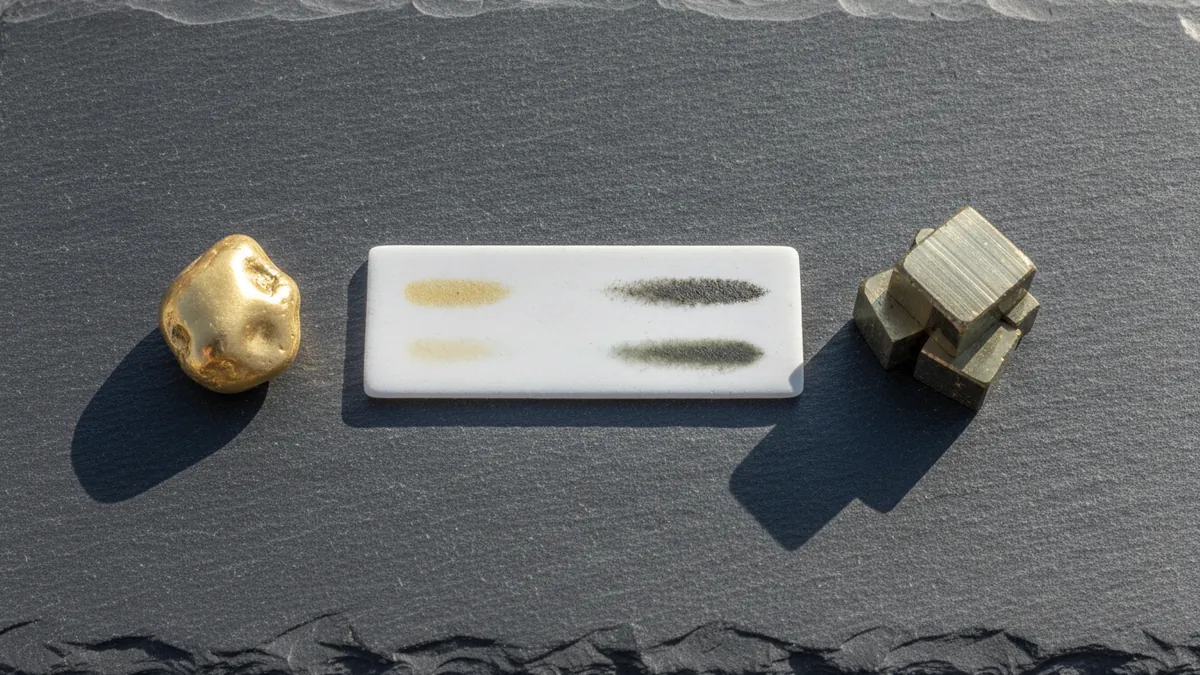
Pyrite vs gold: the short answer
Pyrite is iron sulfide; gold is a native metal. Rub each on the back of an unglazed tile: pyrite leaves a greenish-black streak and gold leaves a yellow one. Press a steel pin into each, and gold dents like soft lead while pyrite resists, then shatters under a hammer. Gold is also three to four times denser and never tarnishes. Chalcopyrite and weathered mica fail the same tests.
Fool's gold is the nickname for pyrite, and it earns it in bright sun, when a pyrite cube and a gold flake both look brassy and expensive. Chalcopyrite, a copper iron sulfide, gets the same nickname in some mining areas. Weathered mica is the third impostor, mostly in creeks. You don't need a lab to sort them out. A piece of unglazed porcelain and a steel pin settle most cases, and the sections below go through each test in the order I'd use them.
Gold, pyrite, chalcopyrite and mica side by side
Read across any row. Gold is the odd one out in almost every line, so one test is usually enough and two tests nearly always are.
| Property | Gold | Pyrite | Chalcopyrite | Weathered mica |
|---|---|---|---|---|
| What it is | Native element, usually alloyed with some silver | Iron sulfide, FeS2 | Copper iron sulfide, CuFeS2 | Sheet silicate, usually biotite |
| Color | Buttery yellow, same in sun and shade | Pale brassy yellow | Deeper brassy yellow, often greenish | Bronze to gold with a pearly sheen |
| Streak | Golden yellow | Greenish-black to brownish-black | Greenish-black | White to pale gray, faint |
| Mohs hardness | 2.5 to 3 | 6 to 6.5 | 3.5 to 4 | About 2 to 3 |
| Pin or knife point | Dents, cuts a smooth groove | Point skids; pyrite can scratch glass | Scratches with a powdery line | Splits into thin sheets |
| Hammer | Flattens | Shatters | Breaks into chips | Flakes apart |
| Specific gravity | 15 to 19.3 | About 5.0 | 4.1 to 4.3 | About 2.8 to 3.1 |
| Typical form | Nuggets, flakes, grains, wire | Striated cubes, pyritohedrons, octahedrons | Mostly massive; crystals uncommon | Thin flat flakes |
| Tarnish | None | Goes dull and brown, can rust | Iridescent blue and purple | Fades and bleaches |
| In a gold pan | Stays at the bottom | Settles with heavy sand | Settles with heavy sand | Washes out easily |
Start with the streak test
If you only run one test, make it this one. Streak is the color of a mineral's powder, and powder ignores the surface shine that makes pyrite look valuable.
- Find unglazed white porcelain. The back of a bathroom tile works, and so does the rough ring on the bottom of many coffee mugs.
- Drag a corner or edge of the specimen firmly across it for about an inch.
- Blow off the loose grains and look at the line in daylight.
Gold leaves a yellow streak, the same color as the metal. Pyrite leaves greenish-black to brownish-black powder, and chalcopyrite leaves greenish-black, which looks wrong for something that yellow. Weathered mica barely marks the plate; you get a faint pale smear at most.
A warning for small finds. Porcelain is harder than gold, so the plate scrapes metal off. On a nugget you won't notice. On one tiny flake you could lose most of it, so use the pin test on flakes instead.
Does it bend or break?
Gold is soft, 2.5 to 3 on the Mohs scale, and it's malleable. Push a pin into it and you leave a dent. Run a knife point across a nugget and it cuts a smooth groove with raised edges, the way a blade marks lead. Hit a flake with a hammer and you get a thinner flake.
Pyrite sits at 6 to 6.5, harder than a steel pin and harder than most pocketknife blades, so the point skids across it. It can even scratch window glass, which gold can't. Under a hammer it breaks into sharp fragments and dark powder, often with a faint sulfur smell.
Chalcopyrite is the tricky middle case. At 3.5 to 4 a knife scratches it, and beginners sometimes read that as proof of a soft metal. Look closely at the scratch. Gold gives a clean, shiny groove; chalcopyrite gives a powdery line and small chips, because it's brittle. If scratch tests are new to you, our guide on how to use the Mohs hardness scale lists which household tools sit at which hardness.
Cubes and striations versus nuggets and flakes
Shape often gives pyrite away before you touch it. Pyrite grows as cubes, frequently with fine parallel grooves called striations, and the grooves on neighboring faces run at right angles to each other. It also forms pyritohedrons (twelve five-sided faces) and octahedrons. Flat faces, sharp corners. Gold almost never looks that tidy.
Natural gold comes as rounded nuggets, flattened flakes, grains, wires and branching leaf shapes. Gold crystals do exist, usually as small octahedrons, but they are rare enough that dealers sell them as high-end specimens. If you found a perfect cube in a road cut, it's pyrite.
Weight is the test you can feel
Pure gold has a specific gravity of 19.3. Natural gold contains some silver, so most nuggets and placer flakes land somewhere between about 15 and 19. Pyrite is about 5. Quartz, the white rock that surrounds a lot of both, is 2.65.
In your hand, a pea-sized nugget feels like a lead fishing sinker. A pyrite cube the same size feels like a heavy pebble and nothing more. Gold panning runs on this difference: you shake and tilt the pan, light sand washes over the lip, and gold works its way to the bottom and stays put. Pyrite and black sand settle too, but gold is the last thing to move when you swirl.
Why does pyrite look darker in the shade?
Much of pyrite's color comes from light bouncing off flat crystal faces. In direct sun it flashes; tilt it into shade and it turns a dull grayish brass. Gold keeps the same buttery yellow at any angle and in shade, an old prospector's check you can run before any tool comes out.
Tarnish tells you more over time. Gold doesn't react with air or water, so a nugget stays bright for centuries. Pyrite oxidizes. Old pieces go dull and brown, and some convert completely to limonite while keeping their cube shape. Chalcopyrite tarnishes to iridescent blue and purple, and the rainbow 'peacock ore' sold in rock shops is usually chalcopyrite treated with acid to bring those colors out.
Weathered mica, the creek-bed impostor
Biotite mica is dark when fresh. After years in a stream or in rotting granite it loses some of its iron and potassium and turns bronze or gold, and a scatter of those flakes in shallow water really does glitter like placer gold. Plenty of first-time panners go home with a vial of it.
Mica is easy to rule out. Poke a flake with a pin and it splits into thinner sheets or crumbles at the edge. Swirl the pan and mica lifts off the bottom and drifts away with the water, while gold stays down. Our page on how to identify river stones covers the other shiny things you'll pull out of a creek.
How to identify gold in rocks and quartz veins
Most hard-rock gold sits in quartz veins, and most of it is too small to see. Pieces with visible gold are uncommon. What you look for first are signs that gold-bearing fluids passed through:
- Rusty quartz. Brown or orange iron oxide staining in white quartz usually means sulfide minerals were there and weathered, and gold often travels with sulfides.
- Boxwork, which is small square or angular holes lined with brown limonite where pyrite cubes dissolved. Free gold sometimes sits in or near these cavities.
- Fresh sulfides such as pyrite and silvery arsenopyrite, which gives off a garlic smell when struck. They turn up in many gold deposits, though they don't prove gold is present.
- Vein edges. Check where quartz meets the darker host rock, and where veins pinch, swell or cross each other.
When a piece looks promising, wet it and go over it with a 10x loupe. Gold specks stay yellow as you turn the rock, while pyrite specks flash and go dark. If you can reach a speck, touch it with a pin.
A kitchen scale can do a rough density check. Weigh the rock dry, then weigh it hanging from a thread fully under water, and divide the dry weight by the difference between the two readings. Plain quartz comes out near 2.65. A clearly higher number means something dense is inside, which might be gold or might be galena or other sulfides. Only an assay lab can tell you how much gold a rock holds, and that applies to pyrite too: in some deposits pyrite carries microscopic 'invisible' gold that no loupe will ever show.
Before you swing a hammer, find out who owns the ground. Mining claims cover a lot of good gold country in the western US, and most parks ban collecting.
Where pyrite is still worth money
Fool's gold has its own market. Collectors pay for crystal quality and a known locality, and a few sources stand out:
- Sharp, mirror-faced cubes from Navajún, Spain, ideally still sitting in their gray matrix.
- Bright crystal clusters from Huanzala and other mines in Peru.
- Pyritohedrons from the island of Elba, Italy.
- Pyrite suns, flat radiating discs from coal mines around Sparta, Illinois.
- Pyritized fossils, such as ammonites in which pyrite replaced the shell.
Tumbled pyrite and loose rough chunks sell for a few dollars. Sharp, undamaged crystals on matrix with a documented locality are a different market, and chipped corners or rust spots cut the price fast. For a wider list, see which crystals are worth money, or read how to take a picture to see how much a crystal is worth.
Store pyrite dry. In humid air some specimens develop pyrite decay, a white or yellowish powder that releases sulfuric acid and can eat through the label and the box. A sealed container with a silica gel packet helps a lot.
Using a gold identifier app on a photo
The scanner at the top of this page gives you a first ID from one photo. A photo captures color, luster and crystal shape well, so a striated pyrite cube is an easy call. It can't weigh a nugget or see a streak, though, and for tiny flakes the pin and tile still have the final word.
If you're out in the field with an iPhone, AI Rock ID is a mineral identifier that names 6,000+ crystals, rocks, minerals, gems and fossils from a single photo. Each result comes with a confidence score plus look-alikes and how to tell them apart, so you can see what else it considered and which test separates them.
On an Android phone the same mineral identifier app needs no account. It lists hardness and streak for each result, which you can check against your own tile and pin, and an AI chat answers follow-ups like why a yellow rock left a black streak. The value range it shows is a rough guide, not an appraisal. You get free scans every day, and PRO removes the limit.
For other finds, the mineral identifier page explains how photo ID handles single minerals, and the rock identifier is the better fit when your piece is more rock than crystal.
Frequently asked questions
Is pyrite worth anything?
Loose or tumbled pyrite sells for a few dollars, but sharp crystals from places like Navajún, Spain, or Huanzala, Peru, are priced as collector mineral specimens. Pyritized fossils and pyrite suns from Illinois also have a collector market.
How can I tell fool's gold from real gold at home?
Rub the piece on the unglazed back of a tile: real gold leaves a yellow streak and fool's gold leaves a greenish-black one. Then press a pin into it, since gold dents and pyrite is too hard to mark.
Can pyrite contain real gold?
Yes, in some ore deposits pyrite holds microscopic gold that you can't see even with a loupe. Only a lab assay will show how much is there.
Is gold magnetic?
No, gold does not stick to a magnet, and pyrite isn't noticeably magnetic either, so a magnet won't separate them. It is still handy when panning for pulling magnetite black sand out of your concentrate.
What does gold look like in quartz?
Gold in quartz shows up as bright yellow specks, grains or thin wires that stay yellow when you turn the rock in shade. It often sits near rusty iron staining or small square holes left by weathered pyrite.
Is chalcopyrite fool's gold?
Chalcopyrite is sometimes called fool's gold because it is brassy yellow, but it is a copper ore with a greenish-black streak. It is harder than gold, brittle, and often tarnishes to iridescent blue and purple.
Why do the gold flakes in my pan float away?
Gold is so dense that it sinks and stays at the bottom, so shiny flakes that drift off in the water are almost always weathered mica. Poke one with a pin and mica will split into thin sheets.
Can a gold identifier app tell pyrite from gold in a photo?
A gold identifier app can usually separate a striated pyrite cube from a nugget by shape and color in one photo. For tiny flakes, a streak and pin test is more reliable because a photo can't measure weight or hardness.