
Rock chart: identify common rocks and the minerals inside them
Work through five quick checks, match your rock against 25 common types, then confirm the minerals inside with a hardness and streak chart. Print it, or snap a photo for a second opinion.


Tap to add a photo, or drop one here
JPG, PNG, WebP, HEIC • Max 50 MB • 1 free scan a day

Analyzing your specimen…
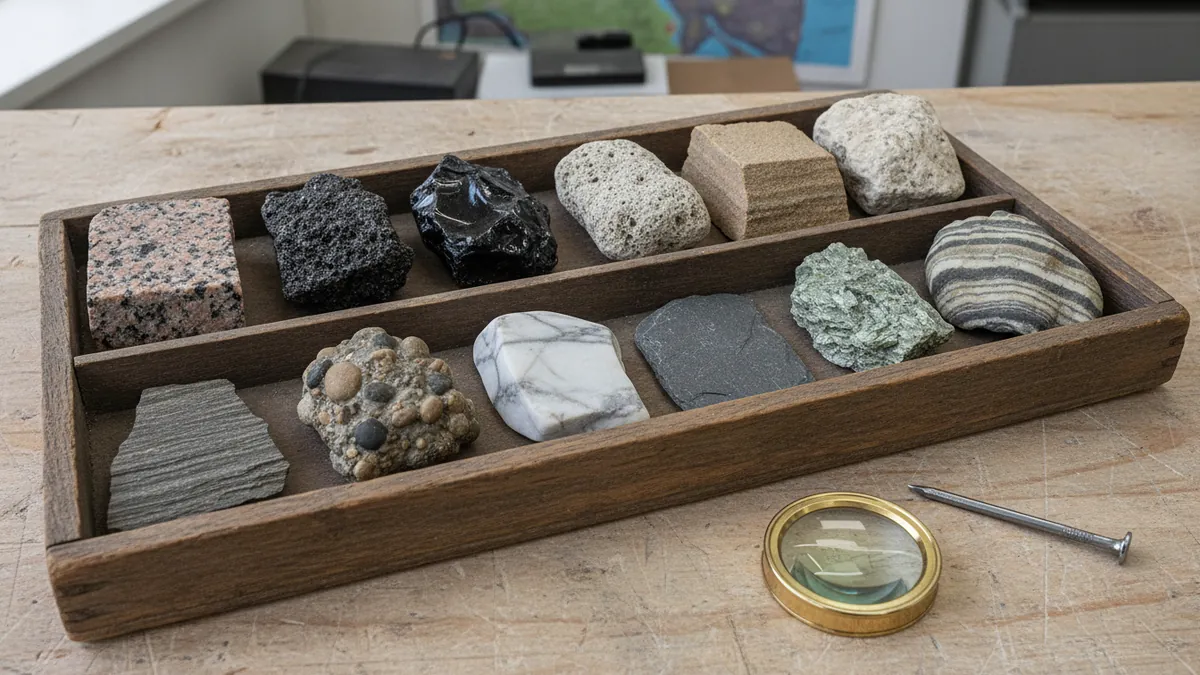
What a rock chart does, and the kit you need
A rock chart sorts unknown rocks by what you can see and test at home. Check first whether the rock is glassy or full of holes, then whether you can see individual grains, whether it has layers or bands, and whether it fizzes in dilute acid. Grain size and color then narrow it to one of about 25 common rocks.
The charts below are built for the rocks people actually pick up in the US: river gravel, road cuts, landscaping rock, beach cobbles. They won't name every rock on Earth. They cover the types beginners run into most, and they lean on tests that cost almost nothing. A rock is a mix of minerals (granite is quartz plus two feldspars plus mica), so there's a second chart for the 15 minerals you'll see inside these rocks. If the difference between those two words feels fuzzy, this explainer on minerals, rocks and crystals sorts it out quickly.
- A 10x hand lens. Phone macro mode works in a pinch.
- A steel nail or pocketknife (hardness about 5.5) and a copper coin (about 3).
- A piece of plain glass, such as an old jar, also about 5.5.
- The unglazed back of a white bathroom tile for streak tests.
- White vinegar, or 10% hydrochloric acid if you have it and wear eye protection.
- A fridge magnet.
Before any test, break the rock or find a fresh chip. Weathering turns granite rusty and basalt brown. Spray the fresh face with water too; wet stone shows grain and color far better than dusty stone.
The five-step decision flow
Go in order. Most rocks drop out by step three.
- Is it glassy or full of holes? Smooth glass with curved, shell-like fracture and razor edges is obsidian. A pale, frothy rock that floats in a bucket of water is pumice. Dark red or black rock with bigger, rougher holes that sinks is scoria, and basalt with only scattered holes is vesicular basalt. All of these are volcanic.
- Can you see separate grains or crystals without a lens? If they interlock like a jigsaw with no gaps, you have a coarse igneous rock (granite, diorite, gabbro, pegmatite) or a metamorphic one, and step 3 tells you which. If the grains are rounded or broken pieces held together by cement, it's sedimentary: sandstone, conglomerate or breccia.
- Are there layers or bands? Flat beds of different grain size or color point to sedimentary rock. Minerals lined up in sheets point to metamorphic foliation: slate splits into flat plates, phyllite has a satin sheen, schist glitters with mica flakes, and gneiss has light and dark stripes of coarse minerals. Granite has no alignment at all.
- Does it fizz? Put a drop of acid on a fresh surface and watch through the lens. Fizzing means calcite, so think limestone, chalk, marble, or a sandstone glued together with calcite cement. Nothing happening? Scrape off some powder and test that. Fizzing only on powder suggests dolomite or dolostone.
- Still fine-grained and unsolved? Look at how it breaks. A smooth, curved, waxy break with sharp edges is chert. A sugary surface where the break cuts straight through the grains is quartzite. A soft rock that splits into thin flakes and smells like wet clay when you breathe on it is shale. Anything left is probably a fine volcanic rock, and color sorts it: black or dark gray for basalt, medium gray for andesite, pink or pale for rhyolite. Tiny holes or scattered crystals in a fine background support the volcanic call.
The flow breaks down on rocks that sit between families. Tuff is volcanic, yet it often looks like a sandy sedimentary rock. Hornfels (a baked, fine metamorphic rock) can pass for basalt. And a beach cobble polished smooth hides its grain until you crack it open. When a rock refuses to fit, write down what each step showed you; that list is exactly what a geology club member will ask for.
Rock identification chart: 25 common rocks
Families first, then texture. Grain sizes use field terms: coarse means grains you can see easily (about 1 mm and up), fine means you need a lens or can't see them at all, and glassy means no grains. For how the three families form in the first place, see igneous vs sedimentary vs metamorphic.
| Rock | Family | Texture | Grain size | Main minerals | How to recognize it |
|---|---|---|---|---|---|
| Granite | Igneous (intrusive) | Interlocking crystals, no layers | Coarse | Quartz, orthoclase, plagioclase, biotite or muscovite | Speckled pink, white and gray; glassy gray quartz plus black mica flecks |
| Pegmatite | Igneous (intrusive) | Interlocking giant crystals | Very coarse, often over 2 cm | Quartz, orthoclase, muscovite | Crystals thumb-sized or bigger; mica in thick stacked books |
| Diorite | Igneous (intrusive) | Interlocking crystals | Coarse | Plagioclase, hornblende, little or no quartz | Salt-and-pepper black and white, no pink |
| Gabbro | Igneous (intrusive) | Interlocking crystals | Coarse | Plagioclase, augite, sometimes olivine | Dark gray to black, heavy for its size, gray feldspar visible |
| Rhyolite | Igneous (extrusive) | Fine background, sometimes flow bands | Fine, may have scattered crystals | Quartz, orthoclase | Pink or pale gray; small quartz or feldspar crystals floating in fine rock |
| Andesite | Igneous (extrusive) | Often porphyritic | Fine with scattered crystals | Plagioclase, hornblende, augite | Medium gray with white feldspar or black needle-like hornblende |
| Basalt | Igneous (extrusive) | Massive or with gas holes | Fine | Plagioclase, augite, olivine | Black to dark gray, heavy; sometimes small green olivine grains |
| Obsidian | Igneous (extrusive) | Glassy | None | Volcanic glass | Black or brown glass, shell-shaped fracture, sharp edges |
| Pumice | Igneous (extrusive) | Frothy, glassy | None | Volcanic glass | Very light and pale, often floats |
| Scoria | Igneous (extrusive) | Vesicular | Fine, riddled with holes | Basaltic glass, plagioclase, augite | Red-brown or black, holes up to pea size, usually sinks |
| Tuff | Igneous (pyroclastic) | Fragmental | Fine to coarse | Volcanic ash, glass shards, pumice bits | Light, soft and porous; like sandstone with pumice chunks |
| Sandstone | Sedimentary (clastic) | Cemented grains | Sand, 1/16 to 2 mm | Quartz, feldspar, cement of silica, calcite or hematite | Feels like sandpaper, grains rub off; tan, red, white or gray |
| Conglomerate | Sedimentary (clastic) | Rounded pebbles in a matrix | Over 2 mm | Quartz, rock fragments | Looks like natural concrete full of rounded pebbles |
| Breccia | Sedimentary (clastic) | Angular fragments in a matrix | Over 2 mm | Rock fragments, calcite or quartz cement | Like conglomerate, but the pieces have sharp corners |
| Shale | Sedimentary (clastic) | Thin layers, splits easily | Clay and silt, too fine to see | Clay minerals such as kaolinite, quartz | Gray or black (sometimes red), smooth, splits into flakes, earthy smell |
| Limestone | Sedimentary (chemical or biochemical) | Massive, often with fossils | Fine to medium | Calcite | Gray or tan, fizzes in acid, knife scratches it, shells common |
| Chalk | Sedimentary (biochemical) | Soft, powdery | Very fine | Calcite | White, writes on a board, fizzes strongly |
| Chert | Sedimentary (chemical) | Massive, smooth | Microcrystalline | Quartz (chalcedony) | Waxy to dull, curved fracture, scratches glass, no fizz; flint is a dark variety |
| Coal | Sedimentary (organic) | Layered | Not grainy | Carbon from plant material | Black, light for its size, black streak, often dirties fingers |
| Slate | Metamorphic (foliated) | Splits into flat sheets | Very fine | Muscovite, chlorite, quartz | Dull, splits into flat plates, may ring when tapped |
| Phyllite | Metamorphic (foliated) | Wavy foliation | Fine | Muscovite, chlorite, quartz | Silky sheen like satin, often crinkled |
| Schist | Metamorphic (foliated) | Flaky, aligned mica | Medium to coarse | Muscovite, biotite, quartz, often garnet | Glitters, flakes peel off, red garnet specks common |
| Gneiss | Metamorphic (foliated) | Banded | Coarse | Orthoclase, plagioclase, quartz, biotite, hornblende | Light and dark stripes, often wavy or folded |
| Marble | Metamorphic (non-foliated) | Interlocking crystals | Fine to coarse | Calcite or dolomite | Sugary sparkle, knife scratches it, calcite marble fizzes |
| Quartzite | Metamorphic (non-foliated) | Fused grains | Fine to medium | Quartz | Sugary, scratches glass, breaks through grains, no fizz |
Read the last column first. The middle columns are there to confirm a guess. A rock that looks like granite but has its dark minerals lined up in stripes is gneiss, and that one detail outranks color every time.
Which look-alikes trip people up?
Seven pairs cause most of the wrong answers. Each has one quick test that settles it.
| Look-alike pair | Quick test |
|---|---|
| Marble or quartzite | Drop acid on it. Calcite marble fizzes and a steel nail scratches it, while quartzite does neither and will scratch glass. |
| Granite or gneiss | Look for stripes. If the dark minerals line up in bands, call it gneiss. |
| Shale or slate | Slate is harder, often rings when tapped, and splits into flat sheets. Shale crumbles into flakes and smells like clay. |
| Pumice or scoria | Water test. Pale pumice usually floats, dark scoria usually sinks. |
| Obsidian or chert | Check the shine. Obsidian looks like bottle glass, and chert looks waxy or dull, closer to a candle. |
| Sandstone or quartzite | Break a corner. Grains that pop out whole mean sandstone. A break that cuts straight through the grains means quartzite. |
| Limestone or dolostone | Scrape some powder. Dolostone barely reacts until it is powdered. |
One more: a dark, heavy rock that grabs a magnet. Most of the time that's a magnetite-rich rock or iron slag left over from old industry (slag usually has gas bubbles). If yours has a thin black crust and no holes, run it through the meteorite tests before you get excited.
Mineral identification chart for the 15 minerals inside these rocks
Hardness is what a mineral scratches and what scratches it. Your fingernail is about 2.5, a copper coin about 3, glass and a steel knife about 5.5. Streak is the color of the powder a mineral leaves on unglazed tile, and it ignores surface color, which is why hematite that looks silver-black still leaves a red-brown line. The Mohs hardness guide covers the scratch test step by step.
Test single grains. A crumbly sandstone can scratch glass because its quartz grains are hardness 7, even while the cement between them falls apart under your thumb.
| Mineral | Hardness (Mohs) | Streak | Luster | Best clue | Common in |
|---|---|---|---|---|---|
| Quartz | 7 | White | Glassy | No cleavage, curved fracture, scratches glass easily | Granite, sandstone, quartzite, chert |
| Orthoclase | 6 | White | Glassy | Pink or cream, two cleavages at right angles, flat shiny faces | Granite, pegmatite, gneiss |
| Plagioclase | 6 to 6.5 | White | Glassy | White to gray, fine parallel striations on cleavage faces | Diorite, gabbro, basalt, andesite |
| Muscovite | 2 to 2.5 | White | Pearly to glassy | Peels into clear, springy sheets | Granite, pegmatite, schist |
| Biotite | 2.5 to 3 | White to gray | Pearly to glassy | Black or dark brown sheets that peel | Granite, schist, gneiss |
| Hornblende | 5 to 6 | Pale gray | Glassy | Black elongated crystals, cleavages at about 56 and 124 degrees | Diorite, andesite, gneiss |
| Augite | 5.5 to 6 | Pale gray to greenish | Glassy to dull | Dark green to black stubby crystals, cleavages near 90 degrees | Gabbro, basalt |
| Olivine | 6.5 to 7 | White | Glassy | Olive-green sugary grains, no cleavage | Basalt, gabbro |
| Calcite | 3 | White | Glassy | Fizzes in cold dilute acid, breaks into rhombs | Limestone, chalk, marble |
| Dolomite | 3.5 to 4 | White | Glassy to pearly | Fizzes only when powdered, often buff or pinkish, curved saddle-shaped crystals | Dolostone, some marble |
| Garnet | 6.5 to 7.5 | White | Glassy | Red-brown ball-shaped crystals with many faces | Schist, gneiss |
| Kaolinite | 2 to 2.5 | White | Earthy | Soft white clay, earthy smell when damp | Shale, weathered granite |
| Chlorite | 2 to 2.5 | Pale green | Pearly | Green flakes that bend but don't spring back | Slate, phyllite, schist |
| Magnetite | 5.5 to 6.5 | Black | Metallic | Strongly magnetic | Basalt, gabbro, black beach sand |
| Hematite | 5 to 6.5 | Red-brown | Metallic to earthy | Red-brown streak whatever the surface color | Cement in red sandstone and shale |
A streak tile is roughly 6.5 to 7 in hardness. Quartz, olivine and garnet are as hard or harder, so they tend to scratch the tile and leave no colored line; white in that column means their powder is white or colorless.
Color is the weakest clue
Quartz alone comes clear, white, pink, purple, smoky brown and nearly black. The feldspar in granite is pink in one quarry and white in the next. Iron stains everything orange. So both charts put color late, after texture, grain size and the scratch test. Once you know the family, though, color earns its keep: basalt is almost never pale, and rhyolite is almost never black (obsidian, black glass with rhyolite chemistry, is the famous exception). If you'd still like to start from color, this guide to identifying rocks by color has that route laid out.
How do you use a printed chart outdoors?
Print this page from your browser in landscape; the six-column rock table fits better that way. Tape the hardness ladder (fingernail 2.5, coin 3, glass 5.5, steel 5.5, tile about 6.5) inside the lid of whatever box you carry samples in. Vinegar travels better in a small dropper bottle than in a sandwich bag, as anyone who has tried the bag knows.
Number each rock with a marker and jot down the step where it dropped out. A notebook full of entries like 'step 3, wavy sheen, splits easily' will teach you more than any chart, this one included.
When the chart gets stuck, try a photo
Any rock identifier chart assumes you can see grain size and run a scratch test. Tumbled stones, tiny chips and weathered cobbles break that assumption fast. Take a sharp daylight photo of a fresh, wet surface and run it through the scanner at the top of this page, then check the result against the tables above. There's also a dedicated photo rock scanner page if you want one to bookmark.
On iPhone, the AI Rock ID rock identifier covers 6,000+ crystals, rocks, minerals, gems and fossils from one photo. Each result has a confidence score, look-alikes with how to tell them apart, and hardness and streak, which lines up with the mineral chart here. It also shows a value range; treat that as a rough guide, since it is not an appraisal.
On Android, the same rock identifier app works without an account. Results save to a collection, so your numbered field rocks end up in one place, and the AI chat takes follow-up questions such as why a gray rock didn't fizz. You get free scans every day, and PRO removes the limit. A low confidence score is your cue to go back to step one with the lens and the nail.
Frequently asked questions
What is the easiest way to identify a rock at home?
Look at a fresh broken surface with a hand lens and decide whether it is glassy, grainy, layered or none of those. Then add a drop of vinegar and a scratch with a steel nail, which narrows most common rocks to two or three candidates.
How do I tell igneous, sedimentary and metamorphic rocks apart?
Igneous rocks have interlocking crystals or glass with no layers, sedimentary rocks have cemented grains, beds or fossils, and metamorphic rocks have minerals lined up in sheets or bands. Marble and quartzite are the main metamorphic rocks without banding.
Can I use vinegar instead of hydrochloric acid to test for calcite?
Yes, white vinegar makes calcite bubble, just slower and weaker than dilute hydrochloric acid. Watch the drop through a hand lens so you don't miss small bubbles.
What is the difference between a rock chart and a mineral chart?
A rock chart sorts whole rocks by family, texture and grain size. A mineral chart lists single minerals by hardness, streak and luster, which you test on individual grains inside the rock.
Why does my rock scratch glass?
It probably contains quartz or feldspar, both harder than glass at about 5.5. Quartzite, chert, granite and many volcanic rocks will scratch a glass jar.
What does a streak test tell you about a mineral?
Streak is the color of a mineral's powder on unglazed porcelain, and it stays the same even when the surface color changes. It is most useful for metallic minerals such as hematite, which always streaks red-brown.
Is there a printable rock identification chart?
This page prints from any browser, and landscape layout fits the 25-rock table best. Keep the hardness ladder and the five-step flow on the same sheet so you can work through them outdoors.