
Shark tooth identifier: which shark did your tooth come from?
Upload a photo of your tooth for a likely species, then check it against this guide to the eight teeth beachcombers find most, from Venice to Calvert Cliffs.


Tap to add a photo, or drop one here
JPG, PNG, WebP, HEIC • Max 50 MB • 1 free scan a day

Analyzing your specimen…
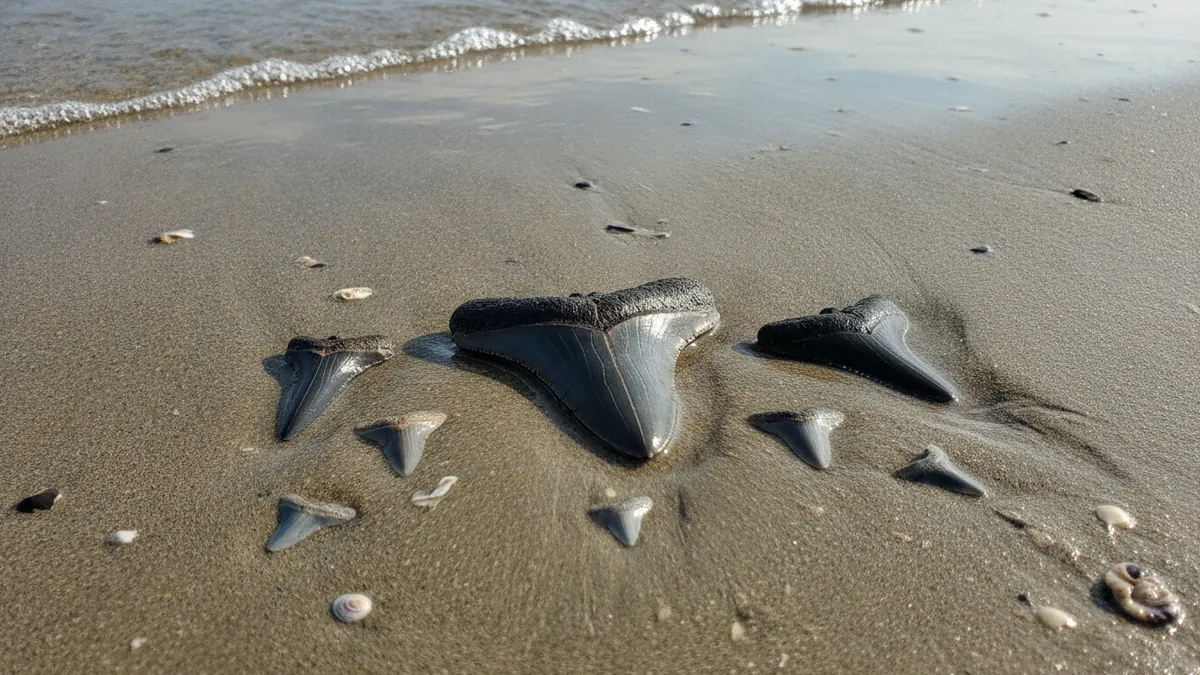
How do you identify a shark tooth?
To identify a shark tooth, look at four things: the outline of the crown (broad triangle, narrow dagger or hooked), whether the edges are serrated or smooth, whether there are tiny side points called cusplets, and the shape of the root. Size and the place you found it narrow the list. Color tells you about age and burial, never species.
Some vocabulary first. The crown is the shiny blade, coated in a hard, glassy layer called enameloid. The root is the matte, often porous base that held the tooth in the gum. On some species a band called the bourlette sits between the two. Cusplets are small extra points on the root shoulders beside the main blade, and serrations are the saw teeth along the cutting edges (on small teeth you'll want a hand lens to see them).
One catch. A single shark grows several tooth shapes. Front teeth are tall and symmetrical, side teeth lean toward the back of the jaw, and upper and lower teeth can look like they came from two different animals; bull sharks have broad serrated uppers and narrow spiky lowers. So a tooth that leans tells you about its position in the jaw. Only sometimes does it tell you about the species.
Eight common teeth compared
| Shark | Tooth shape | Serrations | Typical size | Where found |
|---|---|---|---|---|
| Megalodon (Otodus megalodon) | Big, broad triangle with a thick root and a dark chevron band (bourlette) between crown and root | Fine and even on both edges | About 2 to 7 inches | Peace River, Venice; rare at Calvert Cliffs and Myrtle Beach |
| Great white (Carcharodon carcharias) | Broad, flat triangle with no bourlette | Coarse and easy to see | Up to about 3 inches | Uncommon at Florida and Carolina fossil sites |
| Mako (Isurus and extinct relatives) | Long blade or wide triangle, no cusplets; lower teeth often flick outward at the tip | None | About 1 to 2.5 inches | Calvert Cliffs, Venice |
| Tiger (Galeocerdo) | Cockscomb: crown bent sideways with a notch on the rear edge | Coarse, along both edges | About 0.5 to 1.5 inches | Venice, Calvert Cliffs, Myrtle Beach |
| Bull (Carcharhinus leucas) | Uppers are broad triangles; lowers are narrow upright spikes | Uppers serrated; lowers finely serrated | About 0.5 to 1 inch | Venice, Peace River, Myrtle Beach |
| Lemon (Negaprion brevirostris) | Narrow upright cusp on wide, low shoulders and a flat root | Smooth cusp | About 0.4 to 1 inch | Venice, Peace River, Myrtle Beach |
| Sand tiger (Carcharias taurus) | Slender awl-shaped cusp, one or two cusplets per side, deep U-shaped root | None | About 0.5 to 1.5 inches | Myrtle Beach, Calvert Cliffs, Venice |
| Snaggletooth (Hemipristis serra) | Uppers curved and hooked; lowers narrow and hooked | Large on the rear edge, finer on the front, smooth tip | About 0.5 to 1.5 inches | Venice, Peace River, Calvert Cliffs |
Sizes are for the adult teeth beachcombers usually pick up. A juvenile megalodon tooth can be barely an inch long, which is how plenty of megs end up in someone's 'great white' jar.
Reading the shape, tooth by tooth
Megalodon or great white?
The bourlette settles most of these arguments. Turn the tooth to the tongue side (the side where the root bulges) and look for a dark, chevron-shaped band with a different texture between the shiny crown and the root. Megalodon has it. Great whites don't. Then check the serrations: megalodon edges are fine and even, almost like a steak knife, and a great white's are coarse enough to count without a lens. Size only helps at the extremes. A broad triangular tooth over about 3.5 inches is almost certainly megalodon.
Mako and sand tiger, the smooth-edged pair
Both have long blades with no serrations, and beginners mix them up all the time. Look at the root shoulders. Sand tiger teeth carry cusplets, one or two little spikes on each side; on a beach-worn tooth they're often snapped off, so hunt for the broken stubs. Makos have none. The sand tiger root is also forked deep into two long lobes, like an upside-down U, often with a groove running down the middle.
At Calvert Cliffs you'll also meet the extinct broad-toothed mako, whose upper teeth are wide, flat triangles with smooth edges. Got a big smooth triangle from Maryland? Check that name first.
Tiger shark
Nothing else looks quite like it. The crown is about as wide as it is tall and bends hard toward the back, with a notch where the rear edge drops to a lower heel, and serrations run along everything. Collectors call this a cockscomb shape. Fossil tiger teeth from Calvert Cliffs come from older relatives and tend to be smaller.
Bull and lemon, plus the rest of the requiem sharks
This is where shark tooth identification gets humbling. Bull, lemon, dusky, blacktip and other requiem sharks (family Carcharhinidae) leave small teeth that overlap a lot, and plenty of serious collectors label a worn lower tooth 'Carcharhinus sp.' and move on. I think that's the honest call more often than people admit.
A few habits help. Lemon teeth have a narrow, upright, smooth cusp sitting on wide, low shoulders, and the root is broad and flat, so the whole tooth looks a bit like a T. Bull shark uppers are broad serrated triangles. Bull lowers look a lot like lemon teeth, but under a lens the edges show fine serrations.
Snaggletooth (Hemipristis)
Hemipristis serra is extinct, though a smaller living cousin still swims in the Indian and western Pacific oceans. The upper teeth curve back sharply and carry big, almost hooked serrations along the rear edge, smaller ones on the front edge, and then the serrations stop short of the tip. If you see a smooth point above a heavily serrated, curved blade, you probably have snaggletooth. Lower teeth are slender hooked spikes with few or no serrations and are much harder to place.
Color tells age, not species
There's no such thing as a black shark tooth species. Fossil teeth take their color from the sediment they were buried in: as the tooth fossilizes, minerals from the surrounding ground (phosphate, iron and others) soak into the crown and root. Florida beaches and rivers give mostly black and gray teeth. Calvert Cliffs teeth run tan, brown, orange and blue-gray. So two lemon shark teeth from two states can look nothing alike, and a tiger and a sand tiger from the same Venice beach can be the same charcoal shade.
What color does give you is a rough sense of age. A bright white or ivory tooth with a slightly translucent crown is usually modern, shed by a shark alive today. Black, gray and brown teeth have been buried long enough to mineralize. That's about as precise as color gets. The real age comes from the rock layer a tooth weathered out of, and beach teeth have usually been tumbled out of their layer long ago, so for most Venice finds the honest label is 'fossil, age uncertain.' Some fossil teeth from pale sediments are cream or white, too, which is one more reason to identify by shape.
Tooth or shell fragment? Five checks
In wet shell gravel, a glossy black chip of shell can look exactly like a broken tooth. Run through these before it goes in the jar.
- Find the root. A complete tooth has a matte, slightly porous base under the shiny crown, and even a broken one usually keeps part of it. A shell chip is the same material edge to edge.
- Tilt it in the light. Enameloid is smooth and glassy all over. Black shell from Florida can shine too, but you'll usually see growth lines, ribs or a pearly sheen.
- Look at the broken edge. Shell breaks into thin stacked layers, a little like plywood.
- Feel the thickness. A tooth crown is thickest at the base and thins toward the tip and edges, while a shell fragment is a curved plate of about even thickness.
- Compare the two faces. A shark crown is flat to gently rounded on one side and more rounded on the other; shell is usually domed outside and hollow inside.
Other look-alikes turn up in the same sifter: ray dental plates (flat bars, often with a honeycomb pattern on the side), drum fish teeth (smooth round buttons), fish vertebrae (hourglass-shaped discs) and bone fragments with a spongy interior. All are fossils worth keeping. None are shark teeth. If you're not sure you have a fossil at all, our guide to telling a fossil from a rock imprint covers the basics.
What turns up at four classic spots
- Venice, Florida calls itself the shark tooth capital of the world, and Caspersen Beach is where most people head. Teeth wash in from offshore fossil beds and settle in the shell gravel at the waterline. Expect small black teeth from lemon, bull and other requiem sharks, sand tiger, tiger and snaggletooth, with the odd megalodon. A long-handled sifter (locals call it a Florida snow shovel) saves your back.
- The Peace River, around Arcadia and Wauchula, is where Florida collectors go for bigger teeth, megalodon included. You wade in shallow water and screen gravel, which works best in the dry months when the river is low. Horse teeth, turtle shell and bone come up in the same screen; if you start keeping those, read Florida's fossil permit rules first. Most of the screen is plain gravel, and this guide to identifying river stones helps when a pebble catches your eye.
- Calvert Cliffs on Maryland's Chesapeake Bay shore expose Miocene sediments, and the teeth that fall out are brown, tan and gray. Sand tiger types, broad-toothed mako, snaggletooth and small tiger shark relatives are regular finds. Megalodon is the one everyone hopes for and few get. Search the beach only: the cliffs collapse, and the parks along them prohibit climbing or digging into them.
- Myrtle Beach and the nearby South Carolina coast give mostly small black teeth, with sand tiger and requiem sharks the usual finds. Walk the shell line after a storm or on a falling tide. White modern teeth show up here too.
Using a shark tooth identifier on your phone
A photo can't run a hand lens over serrations, so give it good angles. You can upload a tooth to the scanner at the top of this page, or use our fossil ID page for anything else from the sifter, and you'll get a likely species with look-alikes to compare. A few habits make a big difference:
- Shoot both faces, with the whole root in frame. A crown alone can match three or four species.
- Put a coin or ruler beside it.
- Dry the tooth and use daylight, since wet black enameloid throws glare that hides serrations.
- One tooth per photo, filling most of the frame.
On iPhone, you can install AI Rock ID, a fossil identifier that covers 6,000+ crystals, rocks, minerals, gems and fossils, and scan a tooth while you're still standing on the sand. It returns a confidence score, look-alikes with notes on how to tell them apart, and a value range. Treat that range as a rough guide, not an appraisal: a complete megalodon with sharp serrations and an intact bourlette is worth far more than a chipped one of the same size.
On Android, the same shark tooth identifier app is on Google Play. There's no account to create, you get free scans every day, and PRO removes the limit if you sift for hours. Saved teeth go into a collection, and the AI chat handles follow-up questions like 'bull or dusky?' One honest note: a worn requiem shark lower tooth is hard for any identifier, person or app, and if the confidence score comes back low, the tooth itself is probably the reason.
More photo tips are in our guide to identifying fossils from a photo, and if you want to compare tools, we reviewed the best fossil identifier apps.
Frequently asked questions
How do I know if my shark tooth is a megalodon?
Look for a broad triangular crown with fine, even serrations and a dark chevron-shaped band, the bourlette, between crown and root on the tongue side. Great white teeth lack that band and have coarser serrations.
Is there a free shark tooth identifier app?
AI Rock ID for iPhone and Android identifies shark teeth and other fossils from one photo, with free scans every day and no account needed. PRO removes the daily scan limit.
Why are fossil shark teeth black?
Minerals from the surrounding sediment, such as phosphate and iron compounds, soak into a shark tooth as it fossilizes. Florida sediments tend to turn teeth black or gray, while Calvert Cliffs teeth are usually brown or tan.
Does the color of a shark tooth tell you the species?
No, color reflects the sediment and roughly how long the tooth was buried. Identify the species by crown shape, serrations, cusplets and root.
Are white shark teeth fossils?
Most bright white or ivory shark teeth found on beaches are modern teeth shed by living sharks. Some fossil teeth from pale sediments are also light colored, so a white tooth isn't automatically modern.
What shark teeth are most common in Venice, Florida?
Small black teeth from lemon, bull and other requiem sharks, sand tigers, tiger sharks and the extinct snaggletooth turn up most often at Venice. Megalodon teeth are found there too, but far less often.
How can I tell a shark tooth from a piece of shell?
A shark tooth has a matte root under a glossy crown and thins toward a point. A shell fragment is a curved plate of even thickness with growth lines or thin layers along its broken edges.
Can you identify a shark tooth from a picture?
Usually, if the photo shows both faces, the full root and a coin or ruler for scale. Worn teeth from small requiem sharks are hard to name to species from any photo.