
How to tell if jade is real
Plenty of green stone sold as jade is quartzite, serpentine, glass or aventurine, and some real jadeite is bleached and filled with plastic. These are the tests that catch each one, and the ones that don't.


Tap to add a photo, or drop one here
JPG, PNG, WebP, HEIC • Max 50 MB • 1 free scan a day

Analyzing your specimen…
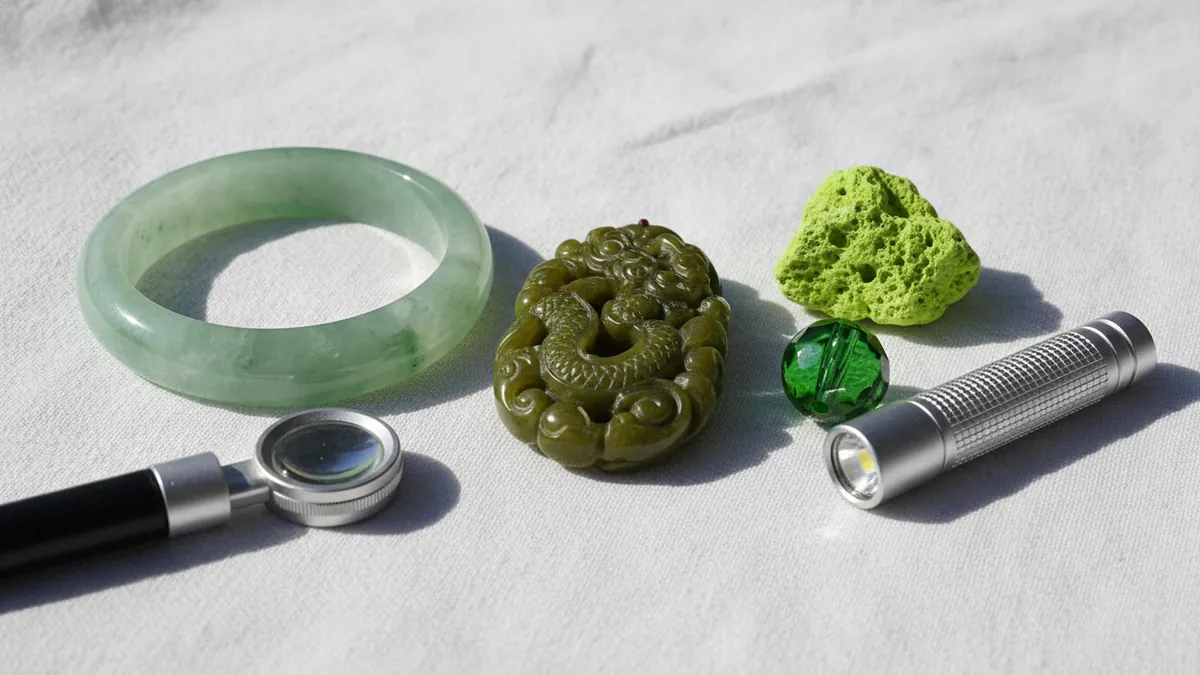
How do you tell if jade is real?
Real jade is one of two minerals, jadeite or nephrite, and both are tough and noticeably dense. At home, the two checks worth doing are a density test with a kitchen scale and a look under a 10x loupe for dye packed into cracks, gas bubbles or glittery mica. Neither catches acid-bleached, polymer-filled jadeite. For that you need a gem lab report.
The word jade on a tag tells you very little. Sellers put it on many green stones, often with a place name in front. Malaysia jade is dyed quartzite, Indian jade is green aventurine, Korea jade is usually serpentine and Mexican jade is dyed calcite. None of them is jade.
So you're answering two questions. Is the stone jadeite or nephrite at all? And if it's jadeite, has someone bleached it, filled it with resin or dyed it? Home tests handle the first question fairly well. The second is lab work, and it's the one with money attached. Most gems split the same way; our guide on telling real gemstones from fakes covers the general method.
Jadeite and nephrite are both jade
Jade isn't a single mineral. In 1863 the French chemist Alexis Damour showed that the green stone arriving in China from Burma was a different mineral from the nephrite Chinese carvers had used for thousands of years. He named it jadeite, and the trade has called both of them jade ever since.
| Property | Jadeite | Nephrite |
|---|---|---|
| Mineral family | Pyroxene | Amphibole (tremolite to actinolite) |
| Mohs hardness | 6.5 to 7 | 6 to 6.5 |
| Specific gravity | about 3.30 to 3.38 | about 2.90 to 3.03 |
| Polished luster | Glassy, sometimes a little greasy | Oily to waxy |
| Typical colors | Pale to emerald green, lavender, white, yellow, orange-red, black | Spinach green, creamy white (mutton fat), gray, black |
| Main sources | Myanmar, plus Guatemala, Japan and Russia | British Columbia, China, New Zealand, Russia, Wyoming |
| Price ceiling | Imperial green is one of the costliest gems sold | Usually lower, though fine white Chinese nephrite can be expensive |
Nephrite is the tougher of the two. Its fibers are matted together like felt, while jadeite is a mass of interlocking grains; both resist breaking better than almost any other gem, which is why Neolithic people made axe heads from them. When people talk about jade selling for thousands, they nearly always mean jadeite, and jadeite is also the one that gets treated.
The common fakes and how they give themselves away
Most imitations fail at least one home test. The table lists the trade names you'll run into and the single check most likely to catch each one.
| Imitation | Often sold as | Hardness | SG | Best giveaway |
|---|---|---|---|---|
| Dyed quartzite | Malaysia jade, Malay jade | 7 | 2.64 to 2.69 | Dye sits in the gaps between grains under a loupe; too light on the scale |
| Serpentine, including bowenite | New jade, Korea jade | 2.5 to 5.5 | 2.5 to 2.6 | A steel pin scratches most of it; light for its size |
| Glass | Plain jade in cheap jewelry | about 5.5 | 2.3 to 2.6, lead glass higher | Round gas bubbles, swirl lines, mold seams |
| Green aventurine | Indian jade | 7 | 2.64 to 2.69 | Tiny mica flakes glitter when you tilt it under a lamp |
| Prehnite | Jade, by some sellers | 6 to 6.5 | 2.80 to 2.95 | Often yellow-green with a radiating texture; overlaps nephrite, so it may need a refractometer |
| Dyed calcite or marble | Mexican jade | 3 | about 2.7 | A knife scratches it easily; dye follows the grain boundaries |
Lead glass breaks the density rule. It can weigh in as heavy as jadeite, so check for bubbles before you trust the scale. Dyed quartzite and aventurine are both quartz, and if that's what you've got, our guide to quartz varieties will help you pin down which one.
Type A, B and C jade: real jadeite that's still a problem
This is the trap for people who have already done their homework. A Type B bangle is genuine jadeite. It passes the density test, it passes the scratch test, it has no bubbles, and it can still be worth a small fraction of an untreated piece.
- Type A is natural jadeite that has only been cleaned and coated with wax, an old and accepted finish.
- Type B jadeite was soaked in acid to strip out brown and yellow stains, then filled with polymer resin to hold it together. It looks cleaner and more translucent than it should, and the resin can yellow or turn brittle over the years.
- Type C is dyed, usually green or lavender, and the dye can fade in strong light.
- Type B+C has had both treatments.
Sometimes a loupe catches Type B. The acid can leave a network of fine etched channels on the polished surface, a bit like dried mud, and some filled stones glow a chalky blue-white under long-wave UV. Plenty of treated pieces show neither sign. Labs use infrared spectroscopy, which detects the polymer directly, and they read the color with a spectroscope, since green jadeite colored by chromium absorbs light in a different pattern from dyed green.
Home tests worth doing
Do these in order. The density test needs a loose stone, so a set ring or pendant skips straight to the loupe.
Density with a kitchen scale
This is the most useful thing you can do at home. You need a scale that reads to 0.01 g, a cup of water and some thin thread. A kitchen scale that only reads whole grams is fine for a bangle and useless for a bead.
- Weigh the dry stone and write the number down.
- Put a cup of water on the scale and tare it to zero.
- Hang the stone on the thread and lower it until it is fully under water, touching neither the sides nor the bottom. The reading in grams is the weight of the water it pushed aside.
- Divide the first number by the second. The result is specific gravity.
Under about 2.7, it isn't jade; that covers quartzite, aventurine, serpentine, calcite and ordinary glass. A result between 2.90 and 3.05 fits nephrite (and, annoyingly, prehnite). Around 3.3 or a little over fits jadeite, or lead glass, which the loupe will catch. A 20 g pendant that comes out at 2.65 is quartz, whatever the tag says.
Loupe and flashlight
A 10x loupe costs less than lunch. Shine a small flashlight through the piece from behind or from the side and look for these:
- Color crowded into cracks and between grains in a spidery pattern. That's dye.
- Round bubbles or curved swirl lines, which mean glass.
- Flat flakes that flash as you rock the stone: aventurine.
- A faintly dimpled polish on jadeite, called orange peel, where neighboring grains took the polish differently. A good sign, not proof.
- A felted, fibrous look inside, typical of nephrite.
Hardness, with care
Both jades sit around 6 to 7 on the Mohs scale, so they scratch window glass and a steel knife won't mark them. Serpentine, calcite and most glass fail. Quartzite and aventurine pass too, because they are harder still, so a pass only rules out the soft fakes. Press an unseen edge of the stone against a glass slide. Never drag a blade across the face of a carving you might want to sell.
Tests that don't prove anything
These get repeated in every market and on every forum. They are folklore.
- Tapping a bangle to hear it ring. The tone depends on shape and thickness, and glass bangles ring nicely too.
- Holding it to see if it stays cold. Any stone or glass feels cooler than plastic, so this only catches plastic and resin.
- The lighter test. Quartzite and glass don't burn either, and a flame can crack jade or scorch the resin in a Type B piece.
- The hair test, where a hair wrapped around real jade supposedly won't burn. Same problem, plus you are holding fire to your jewelry.
- Judging weight in your palm. Two equal-size pieces of jadeite and quartz feel different side by side, but a hand can't separate nephrite from serpentine.
- Holding it up to a light to see a green glow. Every translucent green thing glows green.
Most of these only separate stone from plastic. The common imitations are quartz, serpentine and glass, which feel cold and survive a flame.
What a lab report says, and what a box certificate doesn't
A report from an independent gem lab names the material and says whether the lab found any treatment. When you read one, check for:
- The species, written as jadeite jade or nephrite jade, not just jade.
- A treatment line stating no indications of impregnation or dye, or naming what was found. Some labs print the A, B or C letter; others spell it out in words.
- Weight, measurements and color that match the piece in your hand.
- A report number you can look up on the lab's own website.
Be wary of a certificate that comes in the box from a lab you can't find online. A card reading natural jade may only confirm the species, and a Type B bangle is natural jadeite too. GIA tests jade, and Hong Kong, a long-time hub of the jadeite trade, has several labs that issue jade reports. Turquoise has the same headache with stabilized and dyed stones; see how to tell if turquoise is real if you buy both.
Price warning signs
Top jadeite sells at the level of fine rubies. In 2014 the Hutton-Mdivani necklace, a single strand of 27 jadeite beads, sold at Sotheby's Hong Kong for about US$27.4 million. A translucent, evenly bright green bangle on a market stall for $60 is not a lucky find.
- Strong, even green across a whole bangle for less than a few hundred dollars.
- A-grade, Burma jade or certified on the tag with no lab name or report number.
- Bead strands where every bead matches exactly. Natural jadeite varies from bead to bead.
- Lavender or green that looks stronger in the cracks than in the body.
- A seller who won't take it back if a lab finds treatment.
I'd treat any jadeite without a report as treated, and pay accordingly. Nephrite gets treated less often, mostly with wax, though dyed and heated antique-look pieces exist. For a sense of which stones carry real money, see the most valuable gemstones to identify.
Can a photo tell you if jade is real?
Partly. A photo can sort out the look-alikes that look different: the glitter in aventurine, bubbles in glass, the yellowish cast of a lot of serpentine. It can't weigh the stone or see resin inside it. Upload a sharp, well-lit shot to the scanner at the top of this page and you'll get a best match with a confidence score, plus the look-alikes it weighed and how to tell them apart. Our gemstone scanner page has tips on lighting and angles.
On iPhone, AI Rock ID is a gemstone identifier that names 6,000+ crystals, rocks, minerals, gems and fossils from one photo and lists hardness and streak for each match. There's no account to set up, and you get free scans every day.
If you're on Android, the gem identifier app works the same way. You can save pieces to a collection or ask the AI chat what density a nephrite should give on your scale. It also shows a value range, which is a guide and not an appraisal; for jadeite, the lab report sets the price.
Frequently asked questions
How can I tell if my jade is real at home?
Run a density test with a scale and a cup of water: jadeite comes out around 3.3 and nephrite around 2.95, while quartzite, aventurine, serpentine and most glass sit near 2.6 or lower. Then look under a 10x loupe for dye in cracks, bubbles or mica glitter.
Does real jade scratch glass?
Yes, both jadeite and nephrite scratch ordinary window glass. Quartzite and aventurine do too, so a scratch only rules out soft fakes like serpentine and calcite.
Is real jade cold to the touch?
Real jade feels cool, but so do glass, quartz and every other stone. The temperature test only separates stone from plastic or resin.
What is Type A jade?
Type A is natural jadeite that has only been cleaned and waxed, with no acid bleaching, polymer filling or dye. A report from an independent gem lab is the only way to confirm it.
What is the difference between jadeite and nephrite?
Jadeite is a pyroxene with hardness near 7 and specific gravity around 3.33, and it includes the expensive imperial green. Nephrite is an amphibole, a little softer and lighter at about 2.95, and it is the tougher of the two.
Is Malaysia jade real jade?
No, Malaysia jade is quartzite dyed green. It is much lighter than jadeite on a scale, and under a loupe the dye collects between the grains.
Can a jeweler tell if jade is treated?
A jeweler with a loupe and a UV lamp can sometimes spot dye or resin in jadeite, but many treated pieces show no visible sign. Infrared testing at a gem lab is what confirms untreated jadeite.
Can an app tell if jade is real?
A photo app like AI Rock ID can separate jade from look-alikes such as aventurine, serpentine or glass and explain how to tell them apart. It cannot detect polymer filling or dye in genuine jadeite.