
How to tell if turquoise is real
A lot of blue stone sold as turquoise is dyed howlite, magnesite or plastic. These are the clues to check first, and the home tests worth their risk.


Tap to add a photo, or drop one here
JPG, PNG, WebP, HEIC • Max 50 MB • 1 free scan a day

Analyzing your specimen…
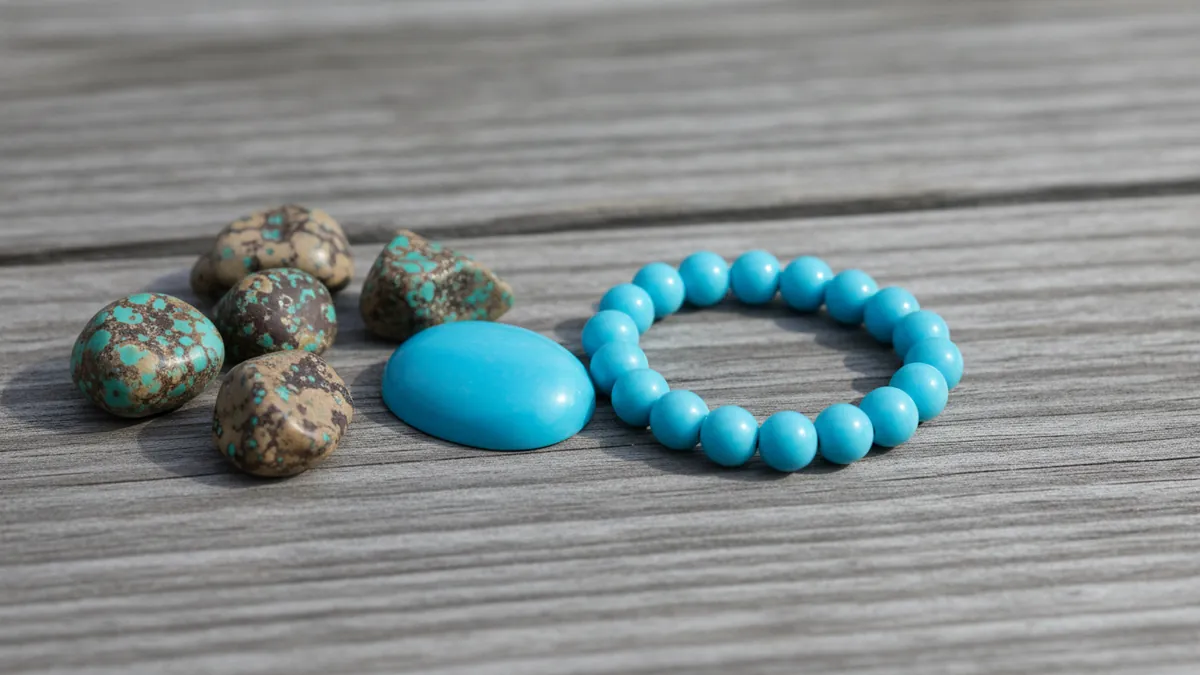
How do you tell if turquoise is real?
Real turquoise is a copper aluminum phosphate with a hardness of 5 to 6 on the Mohs scale. To spot fakes, check that dark matrix sits flush and follows real cracks, look for a white core at chips and drill holes, wipe a hidden spot with acetone for dye, and distrust perfectly even color at a cheap price. Stabilized turquoise is real, just treated.
With turquoise, "real" has levels. At one end is a natural, untreated stone from a known mine. At the other is a dyed plastic bead with black lines pressed into it by a mold. Between them sit stabilized turquoise (genuine stone soaked with clear resin so it can be cut and polished) and reconstituted blocks made from turquoise powder and glue. Any of these is fair to sell when the label is honest. Plenty of labels aren't.
Natural turquoise forms where copper-bearing water seeps through rock in dry climates, which is why the classic sources are the American Southwest, Iran and parts of China. The stone is porous. Untreated lower-grade material feels almost chalky, drinks up skin oils and can drift greener over the years, and that porosity explains both why so much of it gets treated and why a couple of the tests below can harm it.
Real vs fake turquoise: six materials you'll see
Three of these contain turquoise. Three don't.
| Material | What it actually is | Mohs hardness | Quick tell |
|---|---|---|---|
| Natural turquoise | Copper aluminum phosphate, untreated | 5 to 6 | Color a little uneven, may look chalky on unpolished spots, matrix sits in the stone |
| Stabilized turquoise | Natural turquoise impregnated with clear resin | 5 to 6 | Looks natural with a slightly glassy, wet-looking polish; color goes through |
| Reconstituted turquoise | Turquoise powder or chips bonded with resin, often dyed | Varies, often softer | Very even color; grainy, sugary texture under a loupe |
| Dyed howlite | Calcium borosilicate, naturally white with gray veins | About 3.5 | Blue pools darker along the veins; white shows inside drill holes |
| Dyed magnesite | Magnesium carbonate, naturally white | About 3.5 to 4.5 | Chalky white core; dark vein web that can look convincing |
| Block turquoise | Resin or plastic, sometimes with stone powder mixed in | Roughly 2 to 3 | Light and warm in the hand, repeated pattern, mold seams |
Two trade names cause a lot of confusion. "African turquoise" is a mottled green jasper with no turquoise in it. "White turquoise" in bead shops is usually plain howlite or magnesite. Neither is plastic, and both can be pretty, but if you paid for turquoise you got something else.
One more treatment is worth knowing by name. The Zachery process, developed by James Zachery, hardens turquoise and deepens its color without the glassy look of heavy resin. It's hard to detect without lab equipment, so a high-grade stone with suspiciously perfect color could be Zachery-treated even if every home test passes.
Read the matrix before anything else
Matrix is the host rock that got caught up in the turquoise as it grew: brown limonite, black chert or shale, sometimes brassy flecks of pyrite. In natural and stabilized stones, matrix is part of the same polished face. Drag a fingernail across a line. You might feel a tiny step where the matrix took a polish slightly differently. You should not feel a ridge of paint.
Signs the matrix is fake or the stone is dyed:
- Black or gold lines that sit on top of the surface, with a different shine from the stone, or that flake at the edges.
- Grooves cut into the stone and filled with paint. Under a loupe the groove walls look sharp and machine-even.
- A blue halo along every vein, darkest right beside the line and paler in between. That's dye soaking into the cracks of howlite or magnesite.
- The same web pattern on bead after bead, which points to a mold.
Real spiderweb matrix is irregular. Lines thin out, fork, and stop for no obvious reason. Beads cut from the same rough look related, the way siblings do, but no two are copies. If you can line up three beads and the webs match, put the strand down.
Color depth shows up at chips and drill holes
Dye rarely soaks all the way in. Howlite and magnesite take blue well at the surface and less toward the center, so any place the stone was cut, drilled or chipped works like a window. Shine a flashlight into a bead's drill hole and look with a 10x loupe. A white or chalky gray ring around the hole means dye.
Natural turquoise is one color right through, or close to it; a chip in a natural cabochon shows the same blue or green underneath, sometimes a shade lighter. Stabilized stone holds its color through too. Some dealers put dye in the stabilizing resin, though, and that carries color deeper, so a blue interior on its own proves very little.
Look hard at the shade itself. Natural turquoise runs from pale sky blue through robin's egg to apple green, and iron pushes it greener. A saturated, almost electric blue that every stone in the tray shares came out of a dye pot far more often than out of a mine.
Acetone and hot-needle tests, and what they can ruin
Both tests leave a mark of some kind. Do them only on stones you own, on a spot nobody will see, such as the back of a cabochon or the inside of a drill hole. A dealer at a show will not appreciate a lit lighter over the tray.
The acetone swab
- Wet a cotton swab with pure acetone or acetone-based nail polish remover.
- Rub a hidden spot firmly for 10 to 20 seconds.
- Check the cotton. Blue or green on the swab means dye is lifting off the stone.
Acetone can cloud the resin in stabilized and reconstituted stones, strip wax, soften plastic, and loosen the glue that holds a cabochon in its bezel. A clean swab is not a pass, either. Dye sealed under resin won't come off.
The hot needle
Heat a sewing needle in a lighter flame for a few seconds and press the tip against a hidden spot. Plastic softens, takes a dent and gives off a sharp burnt-plastic smell. Stone doesn't dent. The trouble is that heat is bad for turquoise: it can drive water out of the structure and leave a pale or greenish burn spot, and stabilized turquoise may smell of hot resin while being entirely genuine. I'd skip this one on anything you care about.
A scratch with steel
Howlite and magnesite sit around 3.5 to 4.5 on the Mohs scale, and plastic is softer still. A steel needle (about 5.5) bites easily into howlite and does little to good hard turquoise, but chalky natural turquoise is soft too, so a scratch alone proves little. The Mohs hardness guide explains how to tell a true scratch from a line of metal left on the surface.
| Test | What it catches | What it can damage | Can a fake pass it? |
|---|---|---|---|
| Loupe on matrix and drill holes | Dyed howlite and magnesite, painted matrix, molded patterns | Nothing | Yes, if the dye went deep or the resin fake is good |
| Acetone swab | Surface dye | Resin polish, plastic, setting glue | Yes, sealed dye won't lift |
| Hot needle | Plastic and block material | Turquoise itself, plus any resin | Rarely, though real stabilized stone can smell of resin too |
| Steel scratch | Soft howlite, magnesite, plastic | Leaves a permanent scratch | Yes, and chalky natural turquoise can fail it |
Price and seller warning signs
You can rule out a lot of fake turquoise before you touch it. High-grade natural turquoise from a named American or Persian mine costs real money, and untreated stone hard enough to drill into small beads is uncommon. Cheap and perfectly uniform is a combination natural turquoise almost never produces.
- A full strand of matched, evenly blue beads for the price of lunch.
- Labels like "genuine" or "authentic" with nothing about treatment. Ask whether it's natural, stabilized, reconstituted or dyed; a dealer who knows will answer in one word.
- Trade names such as "African turquoise," "white turquoise" or "turquoise howlite," and listings that only say "turquoise color."
- Famous mine names at premium prices with no documentation. The Sleeping Beauty mine in Arizona stopped producing turquoise in 2012, and its name still turns up on a surprising amount of new jewelry.
- A seller who won't let you see the back of a piece or look into the drill holes.
In the US, the FTC's jewelry guides tell sellers to disclose treatments that affect a stone's value, and stabilization and dye are the kind of treatments that guidance covers. That gives you a fair basis to ask and to expect a straight answer. For a broader checklist across other stones, see how to tell a real gemstone from a fake, and if you're thinking of turquoise as something to hold for value, what crystals are worth money puts it in context.
Can a photo app spot fake turquoise?
Partly. A photo can catch the obvious fakes: dyed howlite with blue pooling in its veins, a chalky magnesite bead, a plastic slab whose pattern repeats. It can't test hardness or smell a needle. Stabilizing resin is close to invisible in any picture.
For a first opinion, upload a sharp daylight photo to the scanner at the top of this page, and if there's a chip or drill hole, take a close second shot of it. If the stone turns out to be something else blue, like chrysocolla or lapis, you can identify gemstones by photo from there.
On iPhone, AI Rock ID is a gemstone identifier that names a stone from one photo out of 6,000+ crystals, rocks, minerals, gems and fossils. It shows a confidence score, the look-alikes and how to tell them apart, plus hardness and streak, and the AI chat takes follow-up questions about matrix or color.
On Android, the gemstone identifier app needs no account and gives you free scans every day; PRO removes the limit. Stones you check can go into a collection. It also shows a value range, which is a rough guide and not an appraisal.
When a lab report is worth it
If a piece costs more than you'd shrug off losing, or it's sold as untreated from a specific mine, send it to a gem lab. Infrared spectroscopy picks up resin and plastic, and chemical analysis can flag treatments like the Zachery process that home tests miss. For a $40 pendant, the loupe and the price tag tell you enough.
Jade has the same trouble with dyed and polymer-filled stone, and the jade guide walks through it.
Frequently asked questions
Is stabilized turquoise real turquoise?
Yes, stabilized turquoise is natural turquoise hardened with clear resin. It is fine to buy as long as the seller discloses the treatment and prices it below untreated stone.
What is fake turquoise usually made of?
Most fake turquoise is dyed howlite, dyed magnesite, or resin and plastic block material. Dyed jasper sold as "African turquoise" and glass also turn up.
How can I test turquoise at home without damaging it?
Use a 10x loupe to check whether the matrix sits flush in the stone and whether drill holes or chips show a white core. These visual checks leave no mark, unlike acetone, a hot needle or a scratch test.
Is turquoise with black lines real?
It can be. Natural spiderweb matrix has irregular lines that sit flush in the stone, while painted or molded lines sit on top, repeat from bead to bead, or have blue dye pooling around them.
Will acetone take the color out of real turquoise?
Acetone leaves the turquoise mineral itself alone. It can pull dye out of treated stones and cloud the resin in stabilized pieces, so test only a hidden spot on a stone you own.
Does real turquoise change color over time?
Natural, untreated turquoise can slowly turn greener as it absorbs skin oils, lotion and sweat over years. Stabilized turquoise changes much less because resin fills its pores.
How much should real turquoise cost?
Prices vary hugely by mine, color and treatment, so there is no single number. A full strand of evenly colored beads for a few dollars is almost certainly dyed howlite, magnesite or plastic.