
Types of agate and how to identify them
Snap a photo of your stone, then use the banding and flashlight clues in this guide to tell agate from jasper and dyed look-alikes.


Tap to add a photo, or drop one here
JPG, PNG, WebP, HEIC • Max 50 MB • 1 free scan a day

Analyzing your specimen…
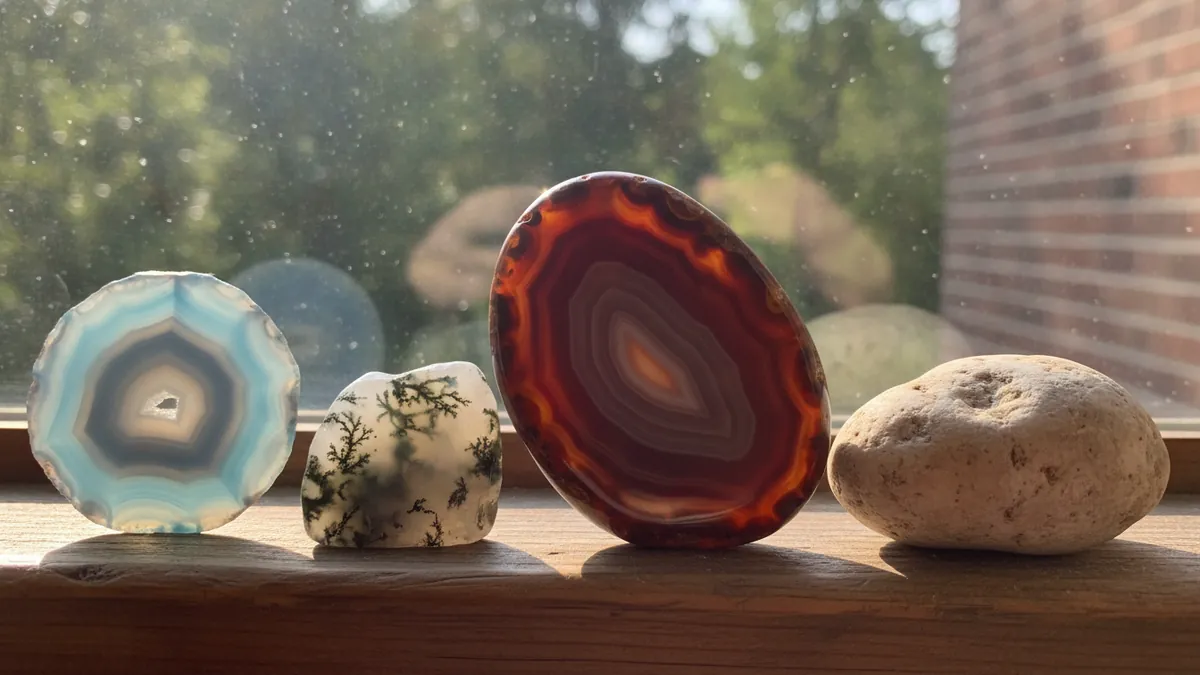
What does agate look like?
Agate is a banded, translucent form of chalcedony, a microcrystalline quartz. Polished, it shows concentric or parallel bands in layers of white, gray, red, orange, brown or blue, with a glassy shine. Rough agate looks like a lumpy, dull nodule with a pitted or frosted rind, but its broken edges look waxy and glow when you shine a flashlight through them.
Polished agate is the version most people picture. A cut slice or tumbled stone shows bands that wrap around each other like tree rings, or stack in flat layers like sediment settling in a jar. Iron oxides give most of the reds, oranges and yellows. Grays, whites and pale blues are close to the natural color of chalcedony itself. Hold a thin slice up to a window and light comes through.
Rough agate is harder. An agate nodule fresh out of its host rock usually has a crust of gray, green or brown that hides everything inside, and after years in a river or on a beach that crust turns frosted, like sandblasted glass. The giveaway is any spot where the skin has chipped. There the stone looks waxy, a bit like hard candy, and you may see the ends of bands as fine parallel lines. Breaks curve like the inside of a seashell. Geologists call that conchoidal fracture, and glass breaks the same way.
Quick physical checks
- Hardness is 6.5 to 7 on the Mohs scale, so agate scratches window glass and a steel knife won't mark it. The Mohs hardness guide explains how to run the test without wrecking a good stone.
- Luster on a fresh break is waxy to glassy. Never metallic.
- Streak is white, like every kind of quartz, which means a streak plate can't separate agate from its relatives.
- It feels about as heavy as any quartz pebble of the same size, with a specific gravity near 2.6.
The flashlight test takes about ten seconds
Translucency is the most useful field clue you have. Agate passes light; jasper, basalt and most ordinary pebbles don't. A phone flashlight works, though a small bright LED torch is easier because you can press the lens right against the stone.
- Get out of direct sun, or cup your hand around the stone. Bright daylight washes out the glow.
- Press the light against the thinnest edge you can find.
- Look at the opposite side and around the rim. Agate lights up with a soft glow (often orange or honey colored on Lake Superior stones), and bands may show as darker lines inside it.
- Turn the stone and try another spot. A thick rind can block light on one face and let it through on another.
A glow alone doesn't prove agate. Plain chalcedony, carnelian, quartz, glass and some calcite pass light too. What the test does well is rule things out: if nothing gets through even at a thin chipped edge, you're probably holding jasper, chert or something outside the quartz family. Wet the stone first. Water fills the frosted skin the way polish would, and the bands often jump out.
Types of agate, side by side
Some agate names describe a place, like Lake Superior or Botswana. Others describe a pattern, like fortification, crazy lace or moss. Dyed agate describes what someone did to the stone after it left the ground. So one stone can carry two names: a Lake Superior agate with angular banding is also a fortification agate.
| Type | What it looks like | Typical colors | Main sources | Best ID clue |
|---|---|---|---|---|
| Lake Superior | Tight bands, often with a pitted, frosted rind from glacial travel | Red, orange, yellow, white, some gray | Glacial gravels of Minnesota, Wisconsin, Michigan and Iowa | Rusty iron colors, with band ends visible in the pits |
| Fire agate | Bubbly, grape-like brown layers with rainbow flashes under the surface | Brown base with green, gold, red and violet flashes | Mexico, Arizona, southern California | Iridescence that shifts as you tilt it |
| Moss agate | Little or no banding; green or black growths that look like moss or ferns inside the stone | Clear, white or gray with green, black or brown inclusions | India, Montana | Branching inclusions in a translucent body |
| Crazy lace | Crowded, tightly folded swirls of bands | White, cream, red, gold, gray | Chihuahua, Mexico | Busy, wavy pattern; often less translucent than other agates |
| Botswana | Very fine, evenly spaced bands | Gray, pink, peach, brown, white | Eastern Botswana | Hair-thin bands in muted pink and gray |
| Blue lace | Pale blue with white lacy or zigzag bands | Sky blue, white | Namibia is the classic source | Soft, pale blue, never neon |
| Fortification | Angular bands that follow the cavity walls, like the outline of a fort | Any | Worldwide, common in Lake Superior and Brazilian agate | Bands with corners and points |
| Dyed agate | Even, saturated color, usually on slices or geode halves | Electric blue, hot pink, purple, bright green | Mostly Brazilian and Uruguayan agate, dyed after cutting | Color pooled in cracks, in shades agate doesn't grow in |
Crazy lace is probably the one beginners mislabel most. Its dense, swirly look reads as jasper at first glance, and on thick pieces the flashlight test can be borderline, so check a thin edge.
Fire agate looks nothing like the others
Its colors come from very thin layers of iron oxide, mainly goethite or limonite, sandwiched between layers of chalcedony. Light bouncing between those layers splits into colors, the same effect you see on a soap bubble. In the rough it's a brown, knobby lump. Cutters grind it down by hand, layer by layer, to expose the fire without going through it.
How to spot dyed agate
Most of the blue, pink and purple agate slices in gift shops are dyed. Agate is slightly porous, and some bands soak up dye more than others, so dyed slabs tend to show deep color in the coarser bands and very little in the dense ones. Look at cracks and the outer rind with a loupe; dye collects there as dark lines. It's still real agate, to be fair. The color just isn't natural, and an honest seller says so. The guide to telling real gemstones from fakes covers dye and other treatments.
Agate vs jasper vs chalcedony vs carnelian
All four are microcrystalline quartz, with crystals too small to see without a microscope. They share hardness and streak and weigh about the same, so the differences come down to light and pattern. If the line between a mineral and a rock is fuzzy for you, the short explainer on minerals, rocks and crystals sorts it out.
| Stone | Translucency | Banding | Color | Quick tell |
|---|---|---|---|---|
| Agate | Translucent, at least at thin edges | Yes, concentric or parallel | Any, often several in one stone | Glows under a flashlight and shows bands |
| Chalcedony | Translucent | None or very faint | White, gray, pale blue, lavender | Glows like agate but looks uniform, often with a bubbly surface |
| Jasper | Opaque | Sometimes, but patterns are usually spots, flows or blotches | Red, yellow, brown, green | No light passes, even at a chipped edge |
| Carnelian | Translucent | Usually none, sometimes faint | Orange to red-brown | Even orange glow |
Put simply, agate is chalcedony with bands. Carnelian is orange to red chalcedony colored by iron, and a lot of commercial carnelian is agate or chalcedony that was heated or dyed to get that orange. Jasper is the opaque relative, packed with enough iron oxides and clay that light can't get through. Stones that are part translucent and part opaque exist too, and collectors call them jasp-agate.
I'd lean on the flashlight more than on color here. Red agate and red jasper can be the exact same shade. For the rest of the quartz family, see how to identify quartz varieties.
Rocks that get mistaken for agate
- Chert and flint. Same quartz family and the same waxy break, but at most a faint glow at a razor-thin edge, and no real banding.
- Glass. Beach glass and slag glass break with the same shell-shaped curves. Look for round gas bubbles, perfectly even color, or swirl marks that look stirred.
- Quartzite. Up close the surface is grainy, almost sugary. Agate breaks smooth.
- Calcite. It can be translucent and even banded, but a steel knife scratches it and it fizzes in dilute acid.
Where do people find agate?
Agate forms where silica-rich water seeps into holes in rock and leaves layer after layer of chalcedony. The classic host is basalt. Gas bubbles in cooling lava leave round cavities, and those cavities slowly fill. When the basalt weathers away, the harder agate survives and ends up in streams, gravel and beach cobbles. Lake Superior agates formed this way in lava flows about 1.1 billion years ago, and glaciers later spread them across the upper Midwest; Minnesota made the Lake Superior agate its state gemstone in 1969.
| Area | What turns up | Where to look |
|---|---|---|
| Lake Superior region | Lake Superior agates | Gravel pits, Lake Superior beaches, plowed fields, road gravel |
| Oregon coast | Clear, white and carnelian-colored agates | Beach gravel, especially after winter storms strip away the sand |
| Montana | Montana moss agate | Gravel bars along the Yellowstone River |
| West Texas | Plume and banded agates | Big Bend region, mostly private land, so ask first |
| Mexico, Arizona, southern California | Fire agate | Desert sites, many of them on private claims |
| Brazil and Uruguay | Most commercial slabs, geodes and dyed agate | Mines; this is where most shop stock comes from |
On a sunny beach or gravel bar, try walking toward a low sun. Light shines through the stones in front of you, and agates light up like little lamps among the dull basalt. Wet gravel right after rain is easier to read than dry. You'll sort through a lot of other cobbles along the way, and the guide to identifying river stones helps with those.
Check collecting rules before you go. National parks prohibit taking rocks, state parks vary, and a private gravel pit needs the owner's permission.
Identifying agate from a photo
A camera can't do the flashlight test for you, so take two pictures: one in normal light and one with light shining through a thin edge. Wet the stone, get close, and keep the bands or a broken face in frame. Then run it through the scanner at the top of this page, or the gemstone identifier if it's a polished piece.
On iPhone, AI Rock ID is a stone identifier that names more than 6,000 crystals, rocks, minerals, gems and fossils from one photo. Each result comes with a confidence score and a list of look-alikes, plus how to tell them apart, which is the whole agate vs jasper vs chalcedony problem in one screen.
If you're on Android, the same rock identifier app shows hardness and streak for each result, a rough value range that isn't an appraisal, a collection for your finds and an AI chat for follow-up questions, like whether an orange glow means carnelian. You don't need an account. Scans are free every day, and PRO removes the limit.
When the app puts agate and jasper close together, the flashlight settles it.
Frequently asked questions
What are the main types of agate?
The types most people run into are Lake Superior, fire, moss, crazy lace, Botswana, blue lace and fortification agate, plus dyed agate sold in shops. Some names describe where the stone came from and others describe its pattern.
How do I know if my rock is agate?
Shine a flashlight through a thin edge: agate glows and often shows bands, while jasper and most ordinary pebbles stay dark. Agate also scratches glass and breaks with a smooth, waxy, shell-shaped surface.
What does raw agate look like?
Raw agate is usually a rounded or lumpy nodule with a dull, frosted or pitted skin in gray, brown, red or orange. Chipped spots look waxy and translucent, and fine band lines often show in the pits.
What is the difference between agate and jasper?
Both are microcrystalline quartz, but agate is translucent and banded, and jasper is opaque because of the iron oxides and clay mixed into it. If light passes through a thin edge, the stone isn't jasper.
Is bright blue agate real?
Bright blue, pink or purple agate is real agate that has been dyed, usually Brazilian material cut into slices. Natural blue lace agate is a soft, pale sky blue.
Is agate worth any money?
Most agate is inexpensive, and common tumbled stones and dyed slices sell for a few dollars. Large Lake Superior agates with bright, tight banding and well-cut fire agate can be worth far more to collectors.
Where can I find agate in the US?
Well-known spots include Lake Superior beaches and gravel pits, the Oregon coast after winter storms and gravel bars on the Yellowstone River in Montana. National parks ban collecting, so check local rules before you pick anything up.
Can an app identify agate from a picture?
Yes, photo identifier apps such as AI Rock ID can name agate and show look-alikes like jasper and chalcedony. Photograph a wet stone up close so the bands are easy to see.