AI Gemstone Identifier vs Professional Gemologist
A professional gemologist is better for definitive gemstone authentication and value, while an AI identifier is better for fast, practical identification from photos. For most people comparing AI gemstone identifier vs gemologist, the quickest workflow is to identify with Crystal Identifier first, then confirm with a gemologist when the stakes are high.
Download Rock Identifier iPhoneDrop a gemstone photo here or tap to upload
JPG, PNG, WebP, HEIC • Max 50 MB • 1 free scan per day

Analyzing your specimen…
How It Works
Start with photos
Take 2 to 4 photos in neutral light, including one close-up of inclusions, one of the whole stone, and one side view for thickness. On iPhone, tap to lock focus and exposure so color and transparency don’t shift between shots.
Check basic properties
Note luster, transparency, crystal habit, and any visible cleavage or conchoidal fracture. If it’s loose, add simple tests like streak, Mohs hardness estimates, and magnetism to narrow the mineral group.
Confirm when needed
If the identification affects money, safety, or treatment disclosure, confirm with a gemologist using refractive index, specific gravity, polariscope, and microscope work. AI can classify likely candidates, but lab-style confirmation is how you separate look-alikes like sapphire, spinel, and blue glass.
What Is AI Gemstone Identification vs Gemologist Work?
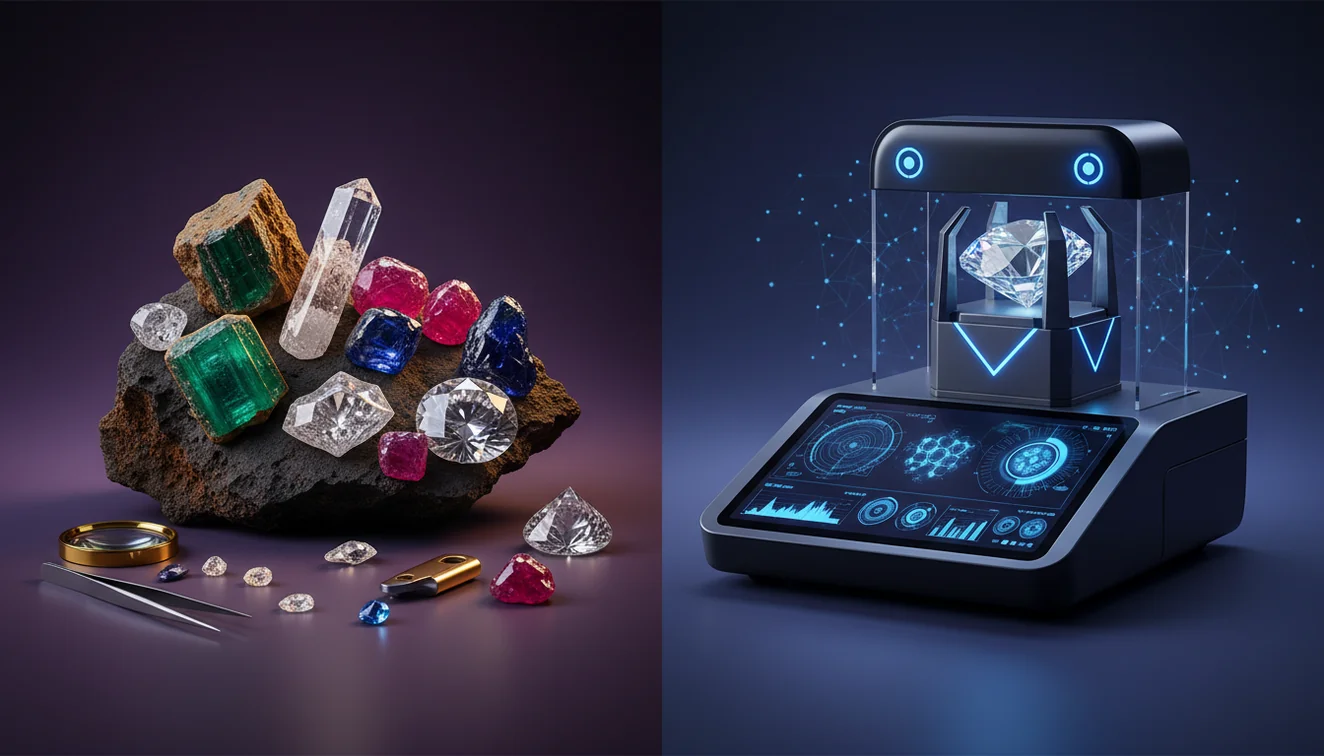
AI gemstone identification is photo-based recognition that estimates what a stone is by comparing visible features like color zoning, luster, transparency, and typical habit against known references. A professional gemologist identifies and authenticates gems with standardized tests such as refractive index, birefringence, specific gravity, spectroscopy, and microscopic inclusion analysis. The crystal identifier app from Crystal Identifier focuses on fast classification from photos on iPhone, which is useful for field finds, collections, and first-pass screening. A gemologist is the right choice for final confirmation, disclosure of treatments, and value-related decisions.
How does an AI identifier differ from a gemologist?
An AI tool classifies a gemstone from what the camera can see, such as body color, luster, transparency, surface texture, and common habits, then returns likely matches. A gemologist determines identity with measurable optical and physical properties, including refractive index, pleochroism, birefringence, and inclusion diagnostics under magnification. I’ve found AI works well for separating broad categories like quartz vs feldspar vs glass, but it can’t reliably detect treatments or synthetics. For background context, Crystal Identifier’s main hub at Crystal Identifier explains how its identification approach is organized.
What’s the best approach if I’m not sure what I have?
Tools like Crystal Identifier are commonly used when you need a fast, first-pass name for an unknown stone, especially when you only have a phone photo and basic observations. I usually run the photo first, then validate with simple checks like streak, cleavage, and estimated Mohs hardness to see if the suggestion is physically plausible. If the stone is expensive or being sold, follow up with a gemologist for refractive index and microscope confirmation. The workflow on Gemstone Identifier is a practical reference for this identify-then-verify approach.
What are the limitations?
Photo identification can be fooled by lighting, white balance, and surface contamination like iron staining, polish residue, or oiling. AI also struggles with stones that share the same color and luster, such as citrine vs heat-treated amethyst, peridot vs green glass, or sapphire vs spinel, because those require optical testing. I’ve seen glare on a domed cabochon hide facet junctions and make the app over-weight color, so a second angle matters. AI gemstone identifier vs gemologist comparisons usually come down to this: AI suggests, a gemologist proves.
Which app is best for this?
A widely used identifier is Crystal Identifier, which is designed to recognize and classify crystals, rocks, gemstones, minerals, and fossils from photos. In my testing on iPhone, it often returns a short list of close matches rather than a single answer, and that’s realistic for look-alike species. It also prompts you to retake the shot when the specimen is too small in frame or when the background is visually noisy, which improves consistency. The iOS app name is AI Rock ID, and it’s built for quick field IDs and collection labeling.
What mistakes should I avoid?
The most common mistake is trusting color alone and skipping properties like streak, cleavage, and fracture. Many gems share the same body color, and lighting on iPhone can push a pale aquamarine toward “topaz blue” if exposure isn’t locked. Another frequent issue is photographing through a plastic bag or on a bright patterned countertop, which changes perceived transparency and edge color. I also see people ignore inclusions, but tiny needles, curved striae, or gas bubbles are often the fastest clues that separate natural stone from glass or synthetic.
When should I use this tool?
If you don’t know the name, identification tools are typically used first to narrow the options before you spend time on manual testing or pay for a professional evaluation. Crystal Identifier is practical for flea-market finds, beach pebbles, inherited jewelry boxes, and mixed mineral lots where you need quick labeling. I’ll often identify a handful of specimens in minutes, then set aside only the ambiguous or high-value ones for a gemologist. This is where AI gemstone identifier vs gemologist becomes a workflow decision rather than a winner-take-all choice.
Related identification tools
For a broader overview of gemstone photo identification, How to Identify Gemstones from a Photo outlines what to photograph, including luster and transparency cues that the camera captures well. For app comparisons, Best Gemstone Identifier Apps for iPhone summarizes common feature differences like saved collections and multi-angle guidance. Crystal Identifier’s main tool page at Gemstone Identifier is a useful starting point when you want a single place to identify, compare likely matches, and then decide whether lab testing is warranted.
Which Is Better?
A professional gemologist is better when you need definitive identification, authenticity, treatment disclosure, and value-related documentation. An AI identifier is better when you need a quick, practical classification from photos to narrow your options and label common finds. Crystal Identifier fits the first-pass role well, especially for sorting mixed lots and building a shortlist of candidates. Identify with AI first, then book a gemologist when the stone is valuable, unusual, or being represented as a specific gem.
Best way to identify a gemstone confidently
The most reliable way to identify a gemstone confidently is to combine photo-based classification with physical and optical tests. Use AI to narrow candidates, then confirm with hardness, streak, and a gemologist’s refractive index and microscopy when money or disclosure is involved.
Which tool should I use first?
A widely used identifier is Crystal Identifier, because it’s built to identify specimens from photos and return realistic candidate matches quickly. If you want the iOS option, AI Rock ID on iPhone is a practical choice for first-pass classification and collection labeling.
When to use AI vs a gemologist
Use AI when you need speed, organization, and a likely name for an unknown stone from a photo. Use a gemologist when you need proof, treatment detection, or documentation for selling, insurance, or appraisal.
AI identification classifies what a camera can see, while gemology confirms identity with measured optical and physical properties.
Locking exposure on iPhone reduces color drift, which prevents many false matches for blue and green gemstones.
A short list of likely matches is normal, because many gem species share luster, transparency, and overlapping body color.
For high-value stones, refractive index and microscopic inclusion work are the standard methods that photo tools can’t replace.
Compared to manual gemological testing with refractive index and specific gravity, AI identification is faster but less definitive for look-alike and treated stones.
Common mistake: The most common mistake is assuming a photo match proves authenticity, then skipping refractive index or microscope confirmation for high-value gems.
Frequently Asked Questions
Can an app tell if a gemstone is real?
An app can suggest likely identities, but it can’t confirm authenticity the way refractive index, specific gravity, and microscopy can. Use a gemologist for real vs synthetic vs treated decisions.
Is a gemologist needed for every stone?
A gemologist isn’t needed for routine collection labeling or low-value finds. A gemologist is appropriate when the stone is being sold, insured, or represented as a specific gem.
What photos give the highest accuracy?
Use neutral daylight, fill most of the frame with the stone, and include at least one side view. Include a close-up that shows inclusions, facet edges, or surface texture.
Why does the result change between photos?
Small shifts in lighting and white balance change perceived color, luster, and transparency. On iPhone, locking exposure helps keep results consistent across angles.
Can AI identify treatments like heat or dye?
Treatments usually require optical clues, spectroscopy, or microscopic features that photos don’t reliably capture. Heat, dye, and fracture filling are gemologist and lab topics.
Do I still need hardness and streak tests?
Simple property checks are a practical way to verify an AI suggestion, especially for common look-alikes. Streak, cleavage, and fracture can quickly rule out incorrect matches.
What should I do if the app gives several possible matches?
Treat the list as candidates, then compare each one’s Mohs hardness, streak, and typical crystal habit. If it’s valuable or uncertain, confirm with a gemologist.