
Stone Identifier: Identify Any Stone by Photo
Free AI stone identifier that tells you exactly what you picked up. Scan river stones, beach pebbles, landscaping gravel, and field finds. Upload a photo and get the mineral name, stone type, Mohs hardness, and estimated value in seconds. Works on smooth, weathered, and freshly broken surfaces alike.
Download Free AppDrag & Drop or Click to Upload
JPG, PNG, WebP, HEIC • Max 50 MB • 1 free scan per day

Analyzing your stone…
How the Stone Identifier Works
Photograph Your Stone
Use natural daylight and a plain background. Wet the stone if the surface looks dusty or dull. A damp surface reveals color banding, grain structure, and translucency that dry specimens conceal entirely.
AI Analyzes the Surface
The scanner evaluates color distribution, luster type, grain size, translucency, and surface texture. It compares these features against a reference dataset of thousands of identified mineral specimens.
Receive Your Identification
Mineral name, stone type, Mohs hardness, formation environment, likely geographic origin, and a value estimate. When confidence is lower, alternative candidates are ranked by probability.
What Is a Stone Identifier
A stone identifier is a visual analysis tool that examines a photograph of a stone and returns the mineral name, composition type, Mohs hardness, and estimated market value. Crystal Identifier uses AI trained on thousands of labeled geological specimens to deliver results in seconds from a single image.
The practical distinction between a stone and a rock is mostly about size and context. Geologists do not maintain a formal boundary. When you pick something up from a riverbed or a beach and hold it in your palm, you call it a stone. When it is part of a cliff face or too heavy to carry, it is a rock. The identification challenge, though, stays the same: figuring out what mineral or combination of minerals you are holding.
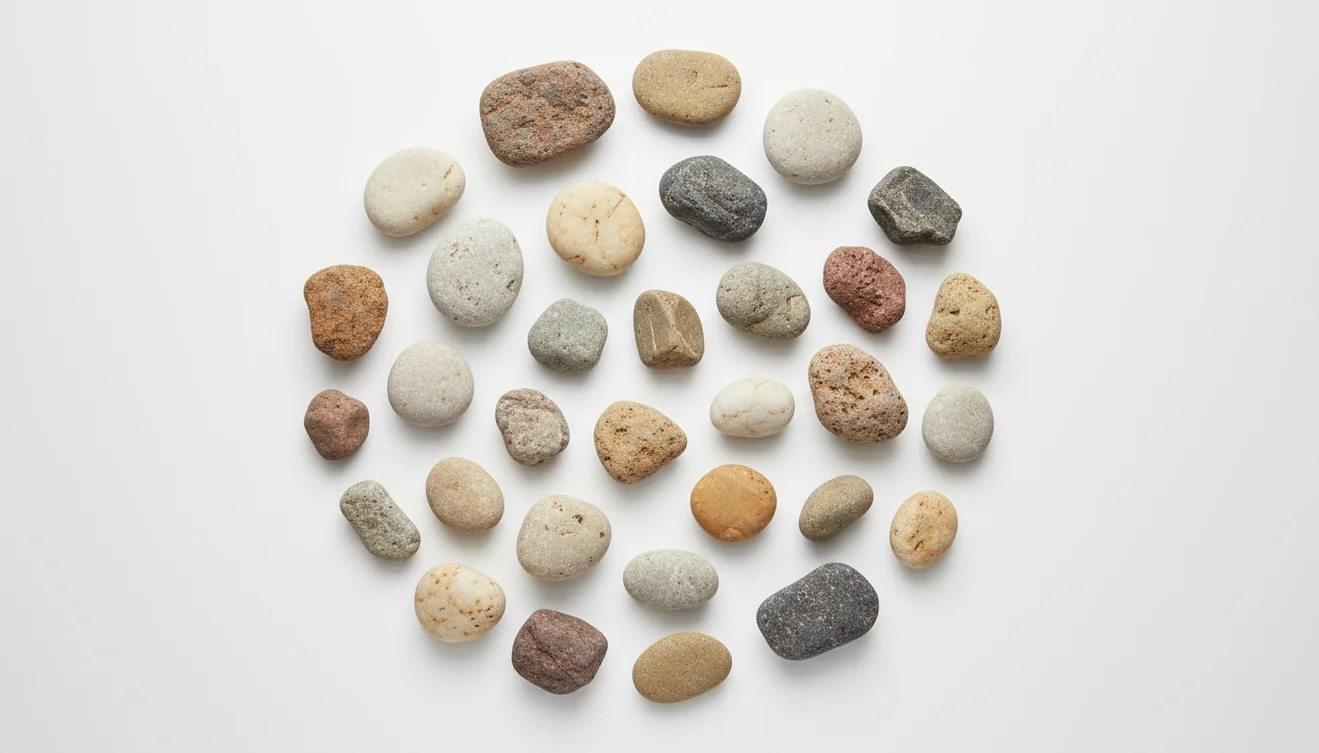
Weathered stones are harder to identify than freshly fractured rock faces. Rivers tumble stones for years, sometimes decades, grinding away the crystal faces and surface textures that geologists rely on for field identification. A chunk of granite pulled from a quarry wall shows clear feldspar crystals, visible mica flakes, and interlocking quartz grains. That same granite after twenty years in a fast-moving creek is a smooth oval with muted color and no obvious mineral boundaries. The AI compensates by leaning harder on color gradients, translucency, and grain-size estimation when surface geometry is gone.
Identifying Beach and River Stones with AI
Beach stones carry their own complications. Salt water, wave action, and sand abrasion produce a uniformly matte surface that masks luster. Many beachcombers collect beautiful stones only to struggle identifying them once they dry and lose the saturated color that caught their attention. Photographing beach finds while still wet dramatically improves scan accuracy.
AI stone identification works best on clean, well-lit specimens. Heavily weathered or mud-covered surfaces reduce accuracy, and rare varieties may require laboratory analysis.
Stone Identifier App
The same AI stone identification engine that powers this website runs inside the Crystal Identifier app. It is free on iOS and Android. You get the same mineral name, stone type, hardness data, and value estimate, but with offline caching so previously scanned specimens load instantly without a network connection.
The app stores a history of every stone you have scanned, which is useful when you return from a beach trip with a pocketful of finds and want to review them later. It also includes a built-in mineral guide covering over 4,000 species, and the ability to ask follow-up questions about any result. Subscribers unlock unlimited daily scans. The free version provides multiple scans per day.
Whether you are sorting river stones at a campsite, picking through landscaping gravel at a garden center, or standing on a rocky shoreline wondering what the tide just uncovered, the stone identifier app gives you a name before you forget which pocket you put it in.
Download Free Stone Identifier AppUnderstanding Stone Identification
How River Stones Form
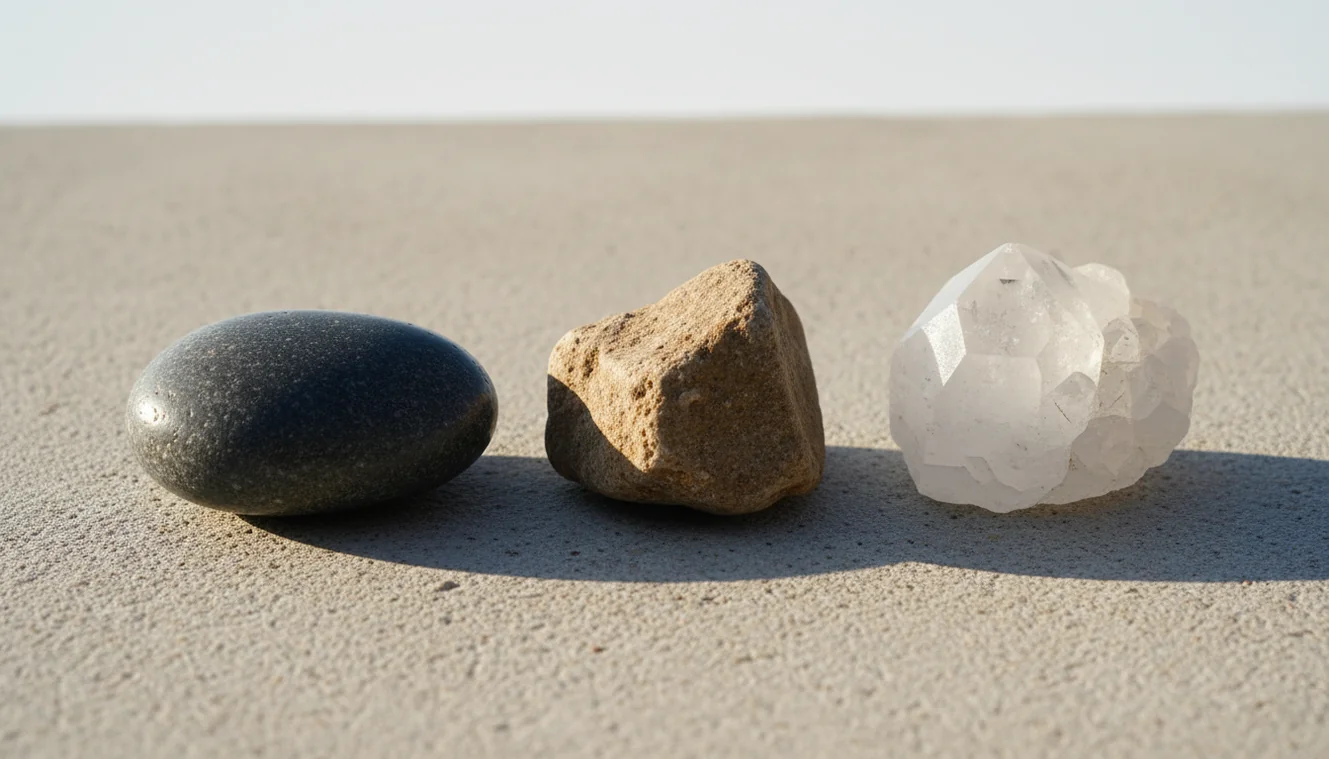
Every river stone started as part of a larger rock mass. Freeze-thaw cycles, root growth, and tectonic stress fracture bedrock into fragments. Moving water carries those fragments downstream, and continuous collision with the riverbed and other stones rounds the edges over time. The distance a stone has traveled correlates roughly with its roundness. Angular stones have not moved far. Perfectly smooth ovals have been in transit for years, sometimes washing out of formations miles upstream from where you find them.
Beach Stone Types
Coastal stone composition depends entirely on local geology and current patterns. Basalt beaches in Iceland produce uniformly dark, dense pebbles. The Great Lakes shoreline delivers agates, Petoskey stones, and banded chert. Mediterranean beaches mix limestone cobbles with the occasional serpentine or jasper. Quartz pebbles show up almost everywhere because quartz resists both chemical and mechanical weathering better than most minerals. When you find a translucent white stone on any beach worldwide, quartz is the safest first guess.
How Tumbling Affects Identification
Natural tumbling erases the two strongest identification signals: crystal habit and fracture pattern. A hexagonal quartz crystal is unmistakable. A tumbled quartz pebble could be mistaken for quartzite, chalcedony, or even feldspar at a glance. The AI shifts its weight toward internal features when external geometry is absent. Translucency depth, color zoning, visible inclusions, and micro-grain texture become primary signals. This is why well-lit photos with accurate color reproduction matter more for tumbled stones than for rough specimens.
Precious vs Common Stones
Most stones you find outdoors are common: granite, basalt, limestone, sandstone, quartz. Valuable finds do happen, though. Agate nodules split open to reveal stunning banding. Garnet crystals weather out of metamorphic host rock and accumulate in stream gravels. Sapphire occurs in certain alluvial deposits. The difference between a $0 stone and a $50 stone often comes down to the specific mineral variety, color saturation, and clarity. Scanning every unusual find costs nothing and occasionally delivers a pleasant surprise.
Stone Collecting Ethics
Public lands often have collection rules. National parks in the United States prohibit removing any natural material. Bureau of Land Management areas typically allow casual collection of reasonable quantities for personal use. Beach collecting laws vary by country and sometimes by municipality. Private land requires the owner's permission. The best practice is checking local regulations before filling your pockets. Collecting responsibly preserves sites for other enthusiasts and keeps you on the right side of land management agencies.
Why Stones Look Different Wet vs Dry
A wet stone always looks more vibrant than the same stone after it dries. Water fills microscopic surface irregularities and reduces light scatter, which lets more light penetrate the outer layer and bounce back with the true body color of the mineral. It is the same optical principle behind polishing. Collectors who tumble-polish their finds are essentially replicating the wet look permanently. For identification purposes, a wet surface is more informative because it reveals color zoning, translucency, and grain boundaries that dry surfaces flatten into a uniform matte.

Related Identification Tools
Each tool uses the same AI engine, tuned for that specific category. Pick the one that matches your specimen.
Frequently Asked Questions
How to identify a stone?
Photograph the stone wet in natural light against a plain background and upload it to an AI stone identifier. The system analyzes color, texture, translucency, and grain pattern to return the mineral name and Mohs hardness.
Rock vs stone?
There is no formal geological distinction. "Stone" typically refers to a smaller, handled piece of rock in everyday language.
Free stone identifier?
Crystal Identifier offers a free web-based stone scanner with one scan per day. The mobile app is free on iOS and Android with additional daily scans.
Why are river stones smooth?
Running water carries stones downstream where continuous collision with the riverbed rounds edges and polishes surfaces over years. Softer minerals smooth faster than harder ones like quartzite.
Identify stones by color?
Color is a useful starting point but unreliable alone since many different minerals share similar colors. AI cross-references color with luster, translucency, and grain texture for accurate identification.
Precious vs semi-precious?
These are trade conventions, not scientific categories. Diamond, ruby, sapphire, and emerald are traditionally called precious; all other gemstones are labeled semi-precious.
Is my stone a meteorite?
Genuine meteorites are dense, usually magnetic, and often display a dark fusion crust. Most suspected meteorites turn out to be industrial slag, magnetite, or hematite.
Are garden stones valuable?
Most garden stones are common varieties with minimal collector value. Occasionally, landscaping gravel includes agate, jasper, or banded iron formation worth keeping.
Common river stones?
Quartz is the most common river stone worldwide because it resists both chemical weathering and physical abrasion. Other frequent finds include chert, quartzite, granite cobbles, and basalt.
AI on tumbled stones?
Yes, though tumbling removes crystal faces and fracture patterns used for identification. The AI relies more on color, translucency, and luster for polished specimens.