
Mineral Identifier: Identify Any Mineral Free
Free AI mineral identifier that returns the mineral name, chemical formula, crystal system, and Mohs hardness from a single photograph. Works as a mineral scanner for raw specimens, polished cabinet pieces, and minerals still embedded in matrix. Upload a photo and get your identification in seconds.
Download Free AppDrag & Drop or Click to Upload
JPG, PNG, WebP, HEIC • Max 50 MB • 1 free scan per day

Analyzing your mineral…
How the Mineral Identifier Works
Photograph Your Mineral
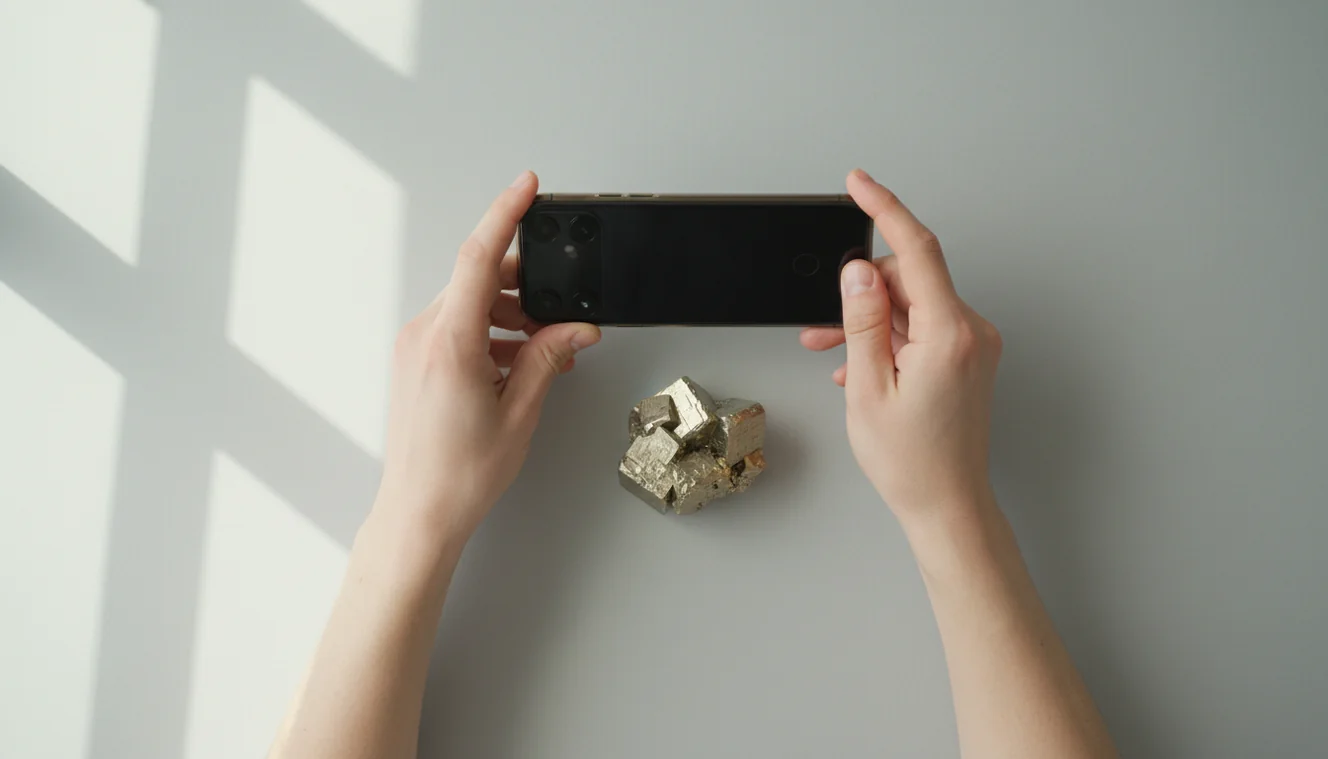
Use natural daylight and a plain background. If the specimen is dusty, wipe it with a damp cloth. Show a fresh fracture surface alongside the weathered exterior when possible — cleavage planes and luster are far more diagnostic than a weathered rind.
AI Reads the Diagnostic Properties
The scanner evaluates luster type, color saturation, crystal habit geometry, cleavage angle, transparency, and surface texture. It compares these against a verified reference dataset spanning thousands of mineral species and their common variations.
Receive Your Identification
Mineral name, chemical formula, crystal system, Mohs hardness, formation environment, and typical localities. When confidence is lower, the AI ranks alternative candidates by probability so you can investigate further.
What Is a Mineral Identifier
A mineral identifier is a diagnostic tool that examines a photograph of a mineral specimen and returns the species name, chemical formula, crystal system, Mohs hardness, and formation context. Crystal Identifier uses AI trained on thousands of verified geological specimens to deliver results in seconds from a single image.
The engine reads the same visual cues a field geologist reads at an outcrop or a sorting bench. Color distribution across the specimen surface. The quality and type of luster — vitreous, adamantine, resinous, silky, metallic, or earthy. The geometry of visible crystal faces and the angles between them. The pattern of breakage surfaces: flat, reflective cleavage planes versus rough, irregular fracture. Each of these properties carries weight, and the AI combines them the way an experienced mineralogist stacks observations to narrow the possibilities.
Chemical formula identification is where the tool moves beyond basic visual matching. When the AI identifies a specimen as pyrite, it does not stop at the name. It returns FeS₂, flags the isometric crystal system, reports a hardness of 6 to 6.5, and notes that pyrite often forms in hydrothermal veins and sedimentary environments. That level of detail matters when you are trying to distinguish pyrite from chalcopyrite (CuFeS₂) or marcasite — same chemistry as pyrite, entirely different crystal structure.
Crystal Systems, Cleavage, and Diagnostic Properties
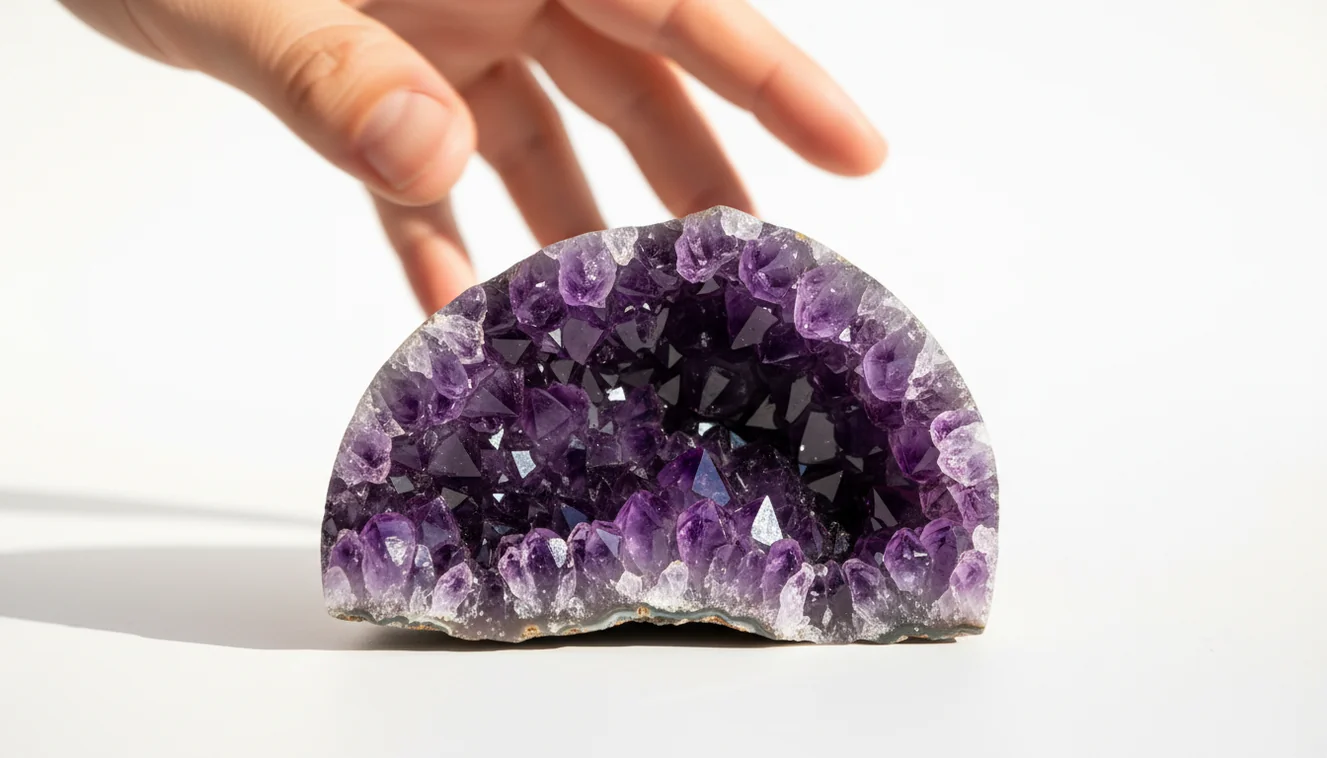
Crystal system classification adds another diagnostic layer. The AI recognizes isometric, tetragonal, hexagonal, orthorhombic, monoclinic, and triclinic geometries from the angles and symmetry of visible crystal faces. A cube with striated faces points to pyrite. A rhombohedral cleavage fragment suggests calcite. A prismatic crystal with a diamond-shaped cross section narrows toward staurolite or andalusite. These geometric fingerprints are often more reliable than color, which varies wildly within a single species.
Where the AI gets genuinely useful is reading the difference between cleavage and fracture from a photograph. Cleavage produces flat, light-reflecting planes that follow the weakest bond directions in the crystal lattice. Fracture produces rough, irregular, or conchoidal surfaces. A specimen that breaks into thin flexible sheets has one-directional perfect cleavage — that is mica. Something that shatters into blocky rectangular fragments with two cleavage directions at roughly 90 degrees is likely feldspar. Three cleavage directions not at 90 degrees? Calcite. The AI reads these breakage patterns from shadow and reflection cues in the image.
The five diagnostic mineral properties that the system evaluates — hardness (inferred from surface wear), luster, cleavage or fracture pattern, crystal habit, and color — form the same checklist that every introductory mineralogy course teaches. The difference is that the AI applies all five simultaneously from visual data rather than requiring you to carry a streak plate, a glass slide, a steel knife, and a bottle of dilute HCl in your pocket.
Some mineral pairs are visually indistinguishable in photographs. Feldspar varieties, for example, require an acid test or thin-section analysis under polarized light for definitive separation. Orthoclase and plagioclase look nearly identical in hand specimen. The AI will flag these ambiguities and suggest which confirmatory test to run, but it cannot replace a petrographic microscope for species-level feldspar identification.
Mineral Identifier App
The same AI mineral identification engine that powers this website runs inside the Crystal Identifier app. It is free on iOS and Android. You get the same mineral name, chemical formula, crystal system, hardness data, and locality information, but with offline caching so previously scanned specimens load instantly without a network connection.
The app keeps a history of every mineral you have scanned. That is useful when you come back from a field trip with a bag full of specimens and need to label them before the memory of where each one came from fades. It also includes a built-in mineral guide covering over 4,000 species, plus the ability to ask follow-up questions about any result — what is the streak color, where does this mineral typically occur, is it associated with any ore deposits.
Whether you are kneeling at a road cut trying to figure out what the shiny flakes in the schist are, sorting through mine dumps on a collecting trip, or examining a specimen tray at a mineral show, the mineral identifier app gives you a name and a formula before you lose track of which piece came from which pocket.
Download Free Mineral Identifier AppUnderstanding Mineral Identification

The 5 Diagnostic Properties
Hardness, luster, streak, cleavage, and crystal habit form the backbone of mineral identification. A steel knife scratches anything below Mohs 5.5. A fingernail stops at 2.5. These simple thresholds slice through dozens of possibilities before you even consider color. Luster separates metallic sulfides from vitreous silicates at a glance. Streak reveals the true body color that surface weathering hides — hematite looks black or silver in hand specimen but always streaks red. Cleavage geometry points directly at the crystal system. When you stack all five, the shortlist rarely exceeds two or three candidates.
Silicate vs Non-Silicate Minerals
Silicates dominate the crust. Quartz, feldspar, mica, olivine, pyroxene, amphibole — all built on silicon-oxygen tetrahedra arranged in chains, sheets, frameworks, or isolated units. Their bonding architecture determines hardness, cleavage, and density. Non-silicates include carbonates like calcite and dolomite, sulfides like pyrite and galena, oxides like hematite and magnetite, and halides like halite and fluorite. The division matters because it predicts chemical behavior. Carbonates fizz in acid. Sulfides tarnish. Halides dissolve in water. Knowing which group a mineral belongs to tells you what tests are worth running.
Ore Minerals and Their Uses
Every metal in your phone, your car, and the building around you started as an ore mineral in the ground. Chalcopyrite (CuFeS₂) is the primary copper ore. Galena (PbS) supplies lead. Sphalerite (ZnS) is the chief zinc source. Hematite (Fe₂O₃) and magnetite (Fe₃O₄) feed steel mills. Bauxite, technically a rock rather than a single mineral, provides aluminum. Identifying ore minerals in the field has direct economic significance, and the AI flags ore-grade species when it recognizes them, noting the metal content and typical extraction context.
Mineral Collecting and Locality Significance
Locality transforms a mineral from a generic specimen into a piece of geological history. A fluorite cube is interesting. A fluorite cube from the Rogerley Mine in Weardale, England — daylight fluorescent green — commands serious collector money. Tsavorite garnet from Merelani, Tanzania. Rhodochrosite from the Sweet Home Mine, Colorado. Amazonite from Pikes Peak. Provenance documentation, original labels, and dealer lineage all factor into value. The AI cannot verify locality, but knowing where a mineral was collected helps confirm the identification by cross-referencing species against known deposit types.
Cleavage vs Fracture Explained
Cleavage is the tendency to break along crystallographically defined planes. Muscovite mica peels into paper-thin sheets along its basal cleavage — you can separate flakes with a fingernail. Galena cleaves into perfect cubes. Calcite breaks along three planes that are not perpendicular, producing rhombohedra. Fracture, by contrast, is a break that does not follow a crystal plane. Quartz has no cleavage; it fractures conchoidally, producing curved, shell-like surfaces. Obsidian does the same. The distinction is critical because cleavage is structurally determined and repeatable, while fracture is essentially random. Seeing flat, shiny break surfaces on a specimen almost always means cleavage, and that tells you far more about identity than color ever will.
Fluorescent Minerals Under UV
Some minerals emit visible light when exposed to ultraviolet radiation, a property called fluorescence. The effect occurs when UV photons excite electrons in trace impurities or structural defects, and those electrons release energy as visible light when they return to ground state. Fluorite — the mineral that gave fluorescence its name — commonly glows blue or purple under longwave UV. Calcite can fluoresce red, pink, or orange depending on manganese or lead activators. Willemite from Franklin, New Jersey produces an intense green glow. Scheelite fluoresces bright bluish-white, which tungsten prospectors have exploited for decades using UV lamps at night. Not every specimen of a fluorescent species will glow; the response depends on specific trace chemistry at the individual locality.
Related Identification Tools
Each tool uses the same AI engine, tuned for that specific category. Pick the one that matches your specimen.
Frequently Asked Questions
How to identify a mineral?
Photograph the mineral in natural daylight against a plain background and upload it to an AI mineral identifier. The system analyzes color, luster, crystal habit, cleavage, and texture to return the mineral name, chemical formula, crystal system, and Mohs hardness.
Five mineral identification tests?
The five standard tests are hardness, streak, luster, cleavage or fracture, and crystal system. Together they narrow thousands of possible mineral species down to a handful of candidates.
Free mineral identifier?
Crystal Identifier offers a free web-based mineral scanner with one scan per day. The mobile app is free on iOS and Android with additional daily scans.
Most common mineral?
Feldspar is the most abundant mineral group in Earth's crust, making up roughly 60 percent by volume. Quartz is the second most common.
Quartz vs calcite?
Quartz is Mohs 7 and scratches glass; calcite is Mohs 3 and fizzes in dilute hydrochloric acid. Crystal habit also differs — quartz forms hexagonal prisms while calcite forms rhombohedra.
Fluorescent minerals?
Fluorite, calcite, willemite, scheelite, and sodalite are common fluorescent minerals under UV light. The response depends on trace impurity chemistry, so not every specimen will glow.
Can AI identify minerals?
Yes. AI reads luster, crystal geometry, color distribution, and surface texture from a phone photo to identify minerals. Best results come from well-lit photos in natural daylight without flash.
What is mineral cleavage?
Cleavage is the tendency of a mineral to break along flat planes defined by its crystal structure. It is one of the most reliable identification signals because it is structurally consistent across every specimen of the same species.
How are minerals classified?
Minerals are classified by chemical composition into groups: silicates, carbonates, oxides, sulfides, sulfates, halides, and native elements. Within each group, crystal system and specific chemistry determine the species.
What makes minerals valuable?
Rarity, crystal quality, color intensity, locality, and aesthetic appeal drive collector value. Provenance documentation and unusual crystal habits like twins or scepters add significant premium.