
Gemstone Identifier: Identify Any Gem by Photo
Free AI gemstone identifier that names your gem, estimates carat weight, and returns a clarity grade and market value range. Works on rough crystals straight from the mine, faceted stones loose or mounted, cabochons, and polished specimens. Upload a photo and the gem scanner handles the rest. No account, no signup, no cost for your first daily scan.
Download Free AppDrag & Drop or Click to Upload
JPG, PNG, WebP, HEIC • Max 50 MB • 1 free scan per day

Analyzing your gemstone…
How the Gemstone Identifier Works
Photograph Your Gemstone
Use diffused natural daylight or a north-facing window. Place the gem on a plain white or gray surface. Avoid flash, which blows out brilliance and masks body color. For faceted stones, include a top-down table view and a side profile so the scanner can read proportions.
AI Analyzes the Gem
The scanner evaluates body color, color distribution, transparency, luster, cut geometry, and visible inclusions. It compares these against a reference dataset of thousands of verified gemstone specimens spanning rough, cabochon, and faceted cuts.
Receive Your Identification
Gem name, estimated carat weight, clarity grade, likely origin, treatment probability, and a market value range. When confidence is split, the AI ranks alternative candidates by probability so you know what else the stone might be.
What Is a Gemstone Identifier
A gemstone identifier is a tool that analyzes a photograph of a gemstone and returns the gem species, estimated carat weight, clarity grade, likely geographic origin, treatment status, and market value range. Crystal Identifier uses AI trained on thousands of verified gemstone specimens to deliver results in seconds from a single image.
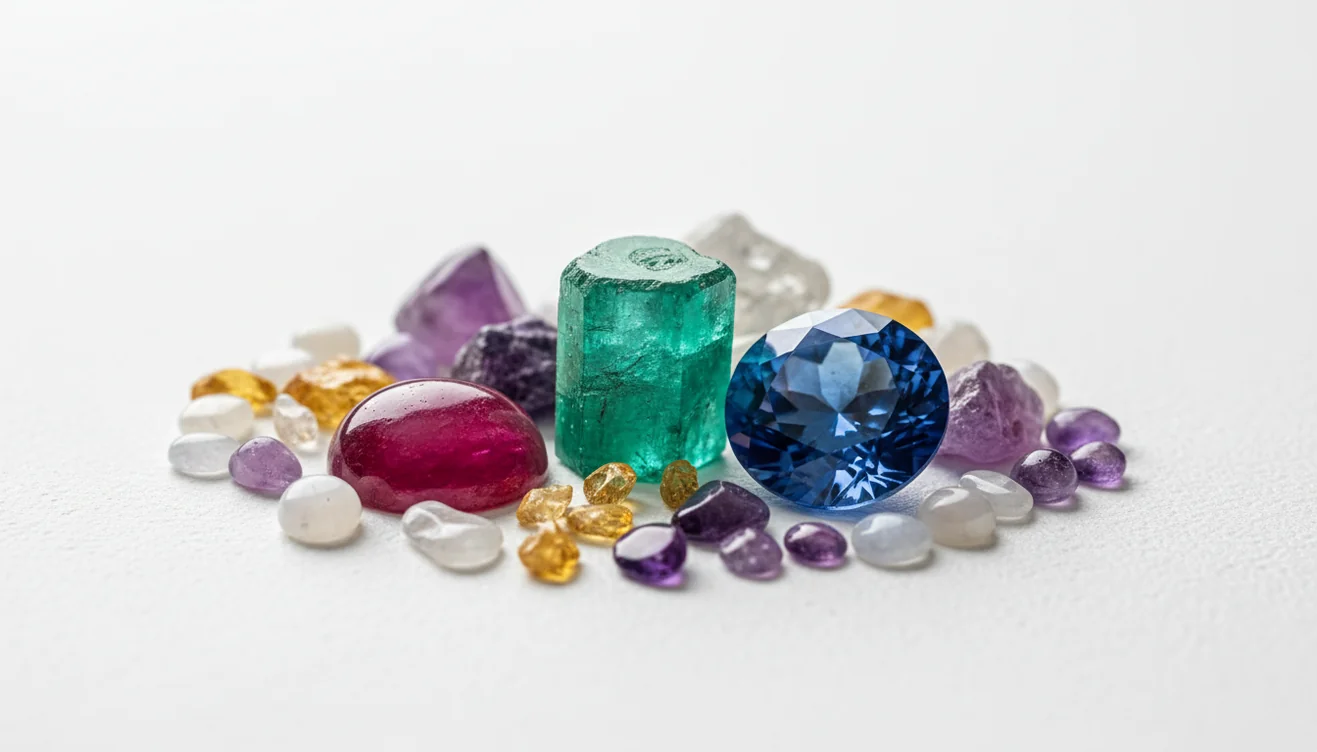
Identifying rough gemstones is a fundamentally different problem than identifying faceted ones. A rough sapphire crystal from Sri Lanka looks nothing like the finished oval in a jewelry case. It arrives as a barrel-shaped hexagonal crystal coated in a gray skin of weathered feldspar. The blue might only show at the tip, or not at all until a window is ground through the surface. The AI has to read the crystal morphology, that distinctive bipyramidal habit corundum grows in, alongside whatever color peeks through the skin. Faceted gems are easier in one sense because the cut reveals body color and transparency clearly, but harder in another: many species look identical once polished. A blue topaz, an aquamarine, and a blue synthetic spinel can sit side by side and fool anyone relying on color alone.
The 4Cs, color, clarity, cut, and carat weight, are the grading framework the gem trade relies on for diamonds and increasingly for colored stones. Evaluating them from a photograph has inherent limits. Color reproduction varies by screen and camera. Clarity requires magnification to grade properly; the AI can spot visible inclusions but not microscopic ones. Cut proportions can be estimated from profile angles but not measured to the tenth of a degree. Carat weight is inferred from visible dimensions and assumed density, not from a scale.
Gemstone Treatments and Synthetic Detection
Then there are treatments. The majority of rubies on the market today have been heat-treated, many with beryllium diffusion or lead-glass fracture filling. Emeralds are routinely oiled or resin-filled to mask jardins. Blue topaz is almost always irradiated. Some treatments are invisible to the naked eye and require advanced spectroscopy. The AI flags obvious indicators, like the telltale orange flash of lead glass in filled rubies, but subtle thermal enhancement leaves no visual trace that any camera can capture.
AI gemstone identification should not be used for insurance appraisals or purchase decisions. Gem grading requires physical measurement of refractive index, specific gravity, and inclusions under magnification.
For a quick field assessment, sorting through estate jewelry, or just figuring out whether that stone you inherited from your grandmother is a genuine ruby or a garnet, the free gemstone scanner delivers a reliable first answer in seconds.
Gemstone Identifier App
The same AI gemstone identification engine that powers this website runs inside the Crystal Identifier app. It is free on iOS and Android. You get the same gem name, carat estimate, clarity grade, origin data, and value range, but without needing a browser. Previously scanned specimens load instantly from the local cache, even offline.
The app keeps a history of every gem you have scanned. That matters when you are walking a Tucson gem show with three hundred tables and need to compare the sapphire at booth 47 with the one you photographed at booth 12. It also includes a built-in gemstone guide covering over 4,000 mineral species, and the ability to ask follow-up questions about any result. Subscribers unlock unlimited daily scans. The free version provides multiple scans per day.
Whether you are sorting a parcel of rough at your desk, browsing an estate sale, or standing at a dealer's table trying to decide before someone else grabs it, the gemstone identifier app puts a second opinion in your pocket.
Download Free Gemstone Identifier AppUnderstanding Gemstone Identification

The 4Cs Explained
Color, clarity, cut, and carat weight form the universal grading language for gemstones. For colored gems, color dominates value. A vivid, evenly saturated hue with medium tone is the ideal. Clarity matters less than in diamonds because most colored stones contain visible inclusions that are considered acceptable. Cut determines how efficiently light returns to the eye; a well-proportioned stone appears more brilliant even at the same carat weight. Carat weight is straightforward mass, but two gems of equal weight can differ wildly in face-up size depending on depth. A shallow-cut sapphire looks larger than a deep one. Dealers call the deep ones "heavy" for a reason: you are paying for weight you cannot see.
Common Gemstone Treatments
Heat treatment is the industry baseline for sapphires and rubies. It dissolves silk inclusions and improves color, and most labs consider it standard disclosure. Beryllium diffusion goes a step further, introducing an element that was never present, and it drops value significantly. Lead-glass filling turns opaque, heavily fractured rubies into transparent-looking stones that shatter if exposed to lemon juice. Emeralds are oiled or resin-filled as routine practice, with cedar oil and Opticon being the most common fillers. Blue topaz in nature is extremely rare; virtually every blue topaz on the market has been irradiated and heated from a colorless precursor. Knowing what is standard versus what is deceptive is the difference between a fair purchase and an expensive mistake.
Rough vs Cut Identification
Rough gemstones arrive coated in matrix rock, weathering rinds, or alluvial dirt. A sapphire crystal from Montana looks like a gray pebble until you hold it to the light and catch a flash of blue through a natural window. Identification at this stage relies on crystal morphology: corundum's hexagonal barrels, tourmaline's striated triangular prisms, beryl's elongated hexagonal columns. Once a stone is faceted, those external clues vanish. The cutter shapes the gem to maximize light return, and a finished blue stone could be sapphire, tanzanite, spinel, kyanite, or iolite. The AI treats rough and cut as distinct identification paths, weighting crystal habit for rough and optical properties for faceted material.
Lab-Grown vs Natural
Lab-grown gems are chemically and optically identical to their natural counterparts. A Chatham emerald has the same refractive index and hardness as a Colombian stone. The difference is origin and rarity. Natural gems formed over millions of years under geological pressure. Lab-grown stones are produced in weeks. Flame-fusion synthetics show curved growth lines visible under magnification. Flux-grown and hydrothermal synthetics are harder to distinguish and may require advanced spectroscopy. For identification purposes, the AI flags obvious synthetic indicators like perfect clarity and uniform color saturation, but definitive separation requires gemological instruments. Price premiums for natural stones range from two to fifty times their lab-grown equivalents, depending on species and quality.
Colored Gemstone Markets
The colored gem trade operates very differently from diamonds. There is no centralized exchange, no standardized price list, and no single grading authority that the entire industry follows. Prices are negotiated stone by stone. A dealer in Chanthaburi, Thailand, may offer a heated Sri Lankan blue sapphire at one price while a dealer in Jaipur quotes a different number for the same size and quality. Auction records from Christie's and Sotheby's set benchmarks for top-tier stones, but the mid-market runs on relationships, reputation, and the buyer's ability to evaluate quality in person. This is exactly why a quick AI scan matters: it gives you a baseline before you negotiate.
How Origin Affects Value
Kashmir sapphires have not been commercially mined since the early 1900s, and that scarcity drives prices into six figures per carat for fine specimens. Burmese pigeon-blood rubies carry a premium because the Mogok Valley has produced the finest red corundum for centuries, and output has declined sharply. Colombian emeralds are prized for their warm, slightly yellowish green that differs from the cooler, bluish green of Zambian material. Paraiba tourmalines from the original Brazilian deposit command fifty times the price of similar-looking cuprian tourmalines from Mozambique. Origin is a provenance story, and the gem market rewards stories with premium pricing. Two stones can be visually indistinguishable yet sell at vastly different prices based on where they came out of the ground.

Related Identification Tools
Each tool uses the same AI engine, tuned for that specific category. Pick the one that matches your specimen.
Frequently Asked Questions
How to identify a gemstone?
Photograph the gemstone in natural light against a plain background and upload it to an AI gemstone identifier. The system analyzes color, transparency, cut, luster, and inclusions to return the gem name, carat estimate, clarity grade, and value range.
Most valuable gemstone?
Blue diamonds have sold for over $3.9 million per carat at auction. Untreated Burmese pigeon-blood rubies and Kashmir sapphires also consistently rank among the most expensive gemstones.
Free gemstone identifier?
Crystal Identifier offers a free web-based gemstone scanner with one scan per day. The mobile app is free on iOS and Android with additional daily scans.
Real vs synthetic gems?
Natural gemstones contain inclusions formed during growth, while synthetics are often too clean or show telltale signs like curved growth lines. Definitive separation requires gemological instruments such as a refractometer or spectroscope.
Precious vs semi-precious?
Traditionally, diamond, ruby, sapphire, and emerald are called precious; all others are semi-precious. The distinction is misleading because top-quality tourmaline or alexandrite can far exceed the price of low-grade sapphire.
Does origin affect gem value?
Yes. Kashmir sapphires, Burmese rubies, and Colombian emeralds command premiums over comparable stones from other localities. Origin adds provenance value that collectors and auction houses price accordingly.
Can AI identify gemstones?
Yes. AI analyzes color, transparency, cut proportions, luster, and inclusions from a photo to identify common gem species like sapphire, ruby, emerald, and garnet. It is a strong first estimate but does not replace hands-on gemological testing.
Rarest gemstones?
Painite, alexandrite, grandidierite, musgravite, and red beryl are among the rarest gemstones on Earth. Rarity does not always equal high price — market awareness, beauty, and durability also factor in.
Gem treatments and value?
Heat treatment of sapphires and rubies is industry standard with minimal price impact. More invasive treatments like lead-glass filling or beryllium diffusion significantly reduce value — untreated gems can sell for two to ten times more.
Mohs scale for gems?
The Mohs scale ranks minerals from 1 (talc) to 10 (diamond) by scratch resistance. It determines gem wearability — sapphire at 9 suits daily-wear rings, while opal at 5.5–6.5 needs protective settings.