
Fossil Identifier: Identify Fossils by Photo
Free AI fossil identifier that returns the species name, geological era, preservation type, and estimated age from a single photograph. Works as a fossil scanner for macrofossils, trace fossils, mineralized specimens, shell impressions, and petrified organic material. Upload a photo of your find and get a detailed identification in seconds.
Download Free AppDrag & Drop or Click to Upload
JPG, PNG, WebP, HEIC • Max 50 MB • 1 free scan per day

Analyzing your fossil…
How the Fossil Identifier Works
Photograph Your Fossil
Brush off loose dirt but do not scrape the surface. Use natural daylight and a plain background. Include the surrounding matrix when possible — the rock type a fossil sits in tells the AI almost as much as the fossil itself. Angle the light to cast shallow shadows across surface detail.
AI Reads the Morphology
The scanner evaluates symmetry, segmentation, surface ornamentation, suture patterns, growth lines, and preservation style. It cross-references these features against a reference dataset of thousands of verified fossil specimens spanning the Precambrian through the Cenozoic.
Receive Your Identification
Species or genus name, geological period, preservation type, estimated age range, and ecological context. When confidence is lower, the AI ranks alternative candidates by probability and flags which diagnostic features would confirm the match.
What Is a Fossil Identifier
A fossil identifier is a visual analysis tool that examines a photograph of a fossil specimen and returns the likely species or genus, geological period, preservation type, and estimated age. Crystal Identifier uses AI trained on thousands of verified paleontological specimens to deliver results in seconds from a single image.
Fossilization is not a single process. It is a family of chemical and physical pathways, and which one preserves your specimen determines what you end up holding. Permineralization fills the cellular structure of bone or wood with dissolved silica, calcite, or pyrite, preserving internal anatomy in three dimensions. This is what produces petrified wood — you can count the growth rings because the mineral replacement happened cell by cell, molecule by molecule, over thousands of years. Cast and mold preservation works differently. The organism dissolves entirely, leaving a negative impression in the surrounding sediment. If mineral-laden groundwater later fills that cavity, you get a cast: a three-dimensional replica of the exterior without any internal structure. Compression fossils form when soft tissue is squeezed flat between layers of accumulating sediment, leaving a thin carbon film that preserves the outline and sometimes fine surface detail. Fern fronds, insect wings, and fish scales fossilize this way in fine-grained shale and mudstone.
AI fossil identification is effective for well-preserved macrofossils but limited for fragmentary specimens, microfossils, or impressions without clear morphological features. Paleontological expertise may be needed for formal classification.
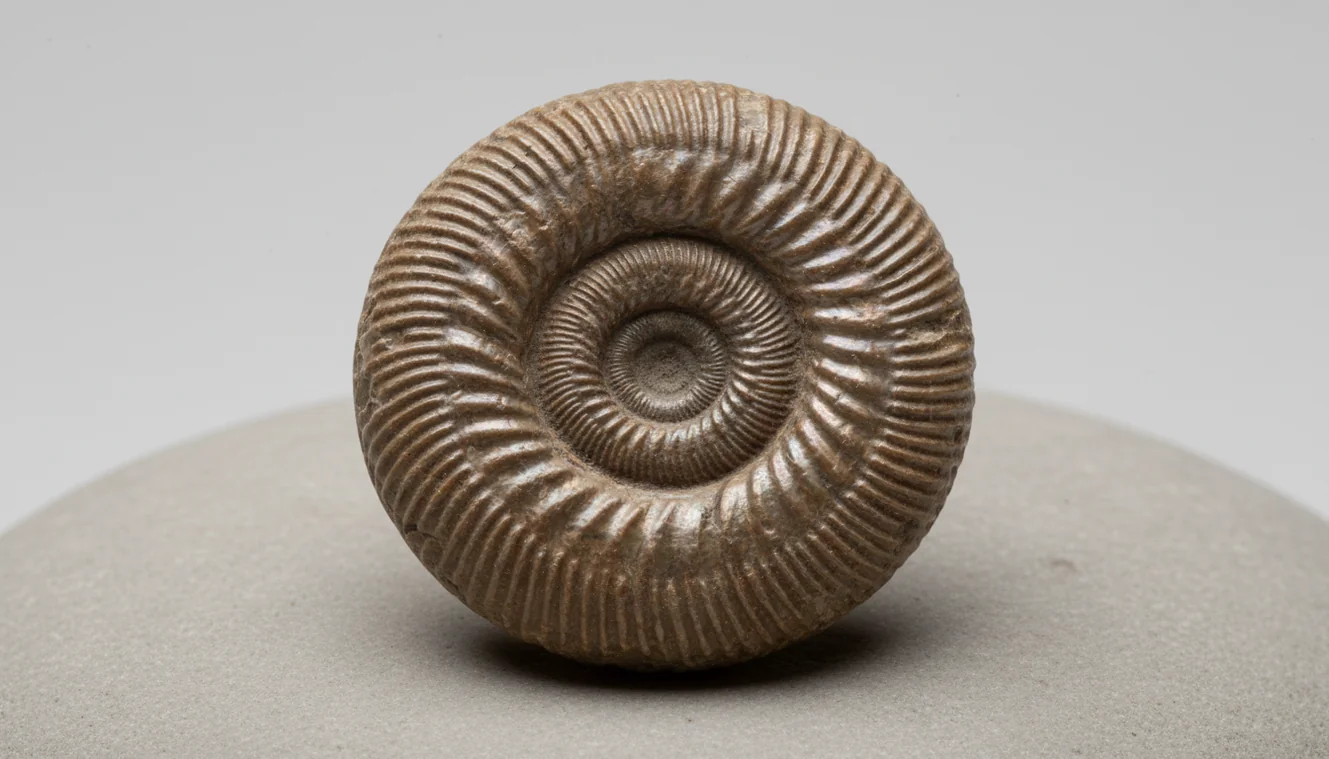
AI Fossil Analysis: From Suture Patterns to Preservation Type
The AI reads preservation signals alongside morphological features. A coiled shell with visible suture lines where the internal chambers meet the outer wall is almost certainly an ammonite. But suture pattern complexity separates Paleozoic goniatites from Mesozoic ceratites and ammonitids — the AI traces the suture geometry to narrow the identification down to family level. A segmented exoskeleton with a distinct cephalon, thorax, and pygidium points to trilobite, but the number of thoracic segments, the shape of the glabella, and the presence or absence of eye lenses separate hundreds of genera. These are the same features a paleontologist reads at a prep bench, except the AI applies them from a photograph in about four seconds.
The free fossil scanner works on shell fossils, bone fragments, plant impressions, trace fossils like burrows and trackways, and petrified material. Upload a photo and the fossil identification engine handles the rest. No account required.
Fossil Identifier App
The same AI fossil identification engine that powers this website runs inside the Crystal Identifier app. It is free on iOS and Android. You get the same species identification, geological era, preservation type, and age estimate, but with offline caching so previously scanned specimens load instantly without a network connection.
The app stores a history of every fossil you have scanned, which matters when you come back from a day splitting shale slabs with a dozen specimens wrapped in newspaper and no memory of which layer each one came from. It also includes a built-in fossil guide, plus the ability to ask follow-up questions about any result — what environment did this organism live in, what other species are typically found alongside it, is this formation known for producing complete specimens.
Whether you are cracking open concretions at a road cut, walking a freshly plowed field looking for weathered-out shells, or examining a specimen tray at a fossil show, the fossil identifier app gives you a name and an era before the context slips away.
Download Free Fossil Identifier AppUnderstanding Fossil Identification
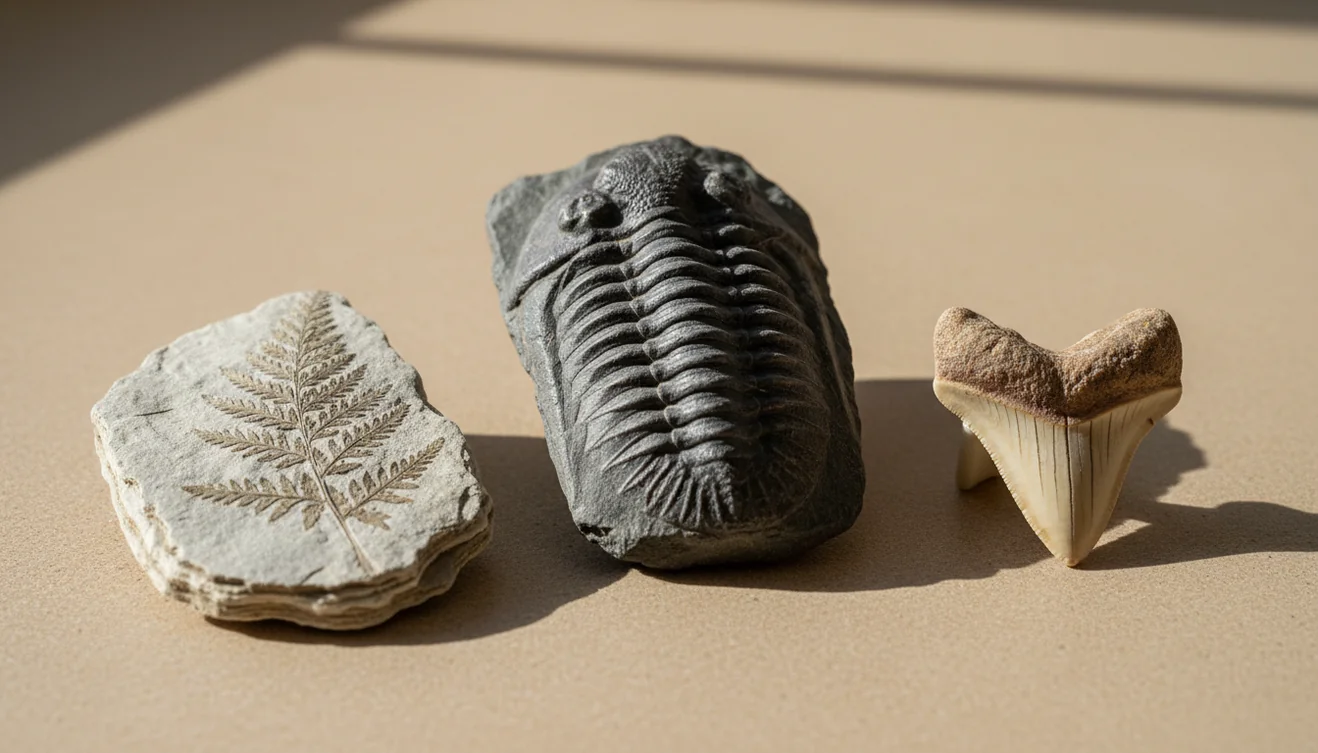
How Fossils Form
Rapid burial is the first requirement. An organism that dies on an exposed surface gets scavenged, weathered, and scattered before sediment can protect it. River deltas, floodplains, shallow marine shelves, and volcanic ash falls create the quick-burial conditions that fossilization demands. Once entombed, the chemistry of the surrounding sediment and groundwater determines the preservation pathway. Silica-rich water produces permineralized bone and petrified wood. Calcite-saturated conditions form casts and replace shell material. Iron-rich anoxic environments generate pyritized fossils — golden replicas of ammonites and gastropods that look like they were cast in metal. The rarest pathway, amber encapsulation, traps insects and plant fragments in tree resin that hardens over millions of years, preserving soft tissue detail that no other process retains.
Common Fossil Types Beginners Find
Crinoid stem segments are everywhere in Paleozoic limestone. They look like small stacked discs or cylindrical beads with a central hole, and people have been finding them in creek beds for centuries. Brachiopods — ribbed, two-valved shells that superficially resemble clams — are the next most common. They dominated shallow seas for hundreds of millions of years. Gastropod steinkerns, the internal sediment casts of snail shells, turn up in road cuts through marine sedimentary rock. Horn corals appear as conical or horn-shaped structures in Devonian and Carboniferous exposures. Shark teeth, especially from the Miocene and Pliocene, wash out of coastal cliffs and river gravels with surprising frequency. None of these require advanced equipment to find. A keen eye and a creek that cuts through the right formation is enough.
Index Fossils and Their Significance
Index fossils solve a fundamental problem in geology: dating rock layers without a mass spectrometer. The ideal index fossil belongs to a species that lived for a geologically short time, spread across a wide geographic area, and is easy to identify. Trilobites index much of the Cambrian and Ordovician. Graptolites date Ordovician and Silurian black shales. Ammonites are the workhorses of Mesozoic biostratigraphy — certain species pin rock strata to windows as narrow as a few million years within the Jurassic and Cretaceous. Foraminifera do the same for deep-marine sediments in the Cenozoic. Finding an index fossil in the field gives you an approximate age for the entire exposure without sending a sample to a radiometric lab.
Fossil vs Concretion: Telling Them Apart
Concretions fool more beginners than any other geological feature. They are rounded, sometimes oddly shaped mineral masses that form within sedimentary rock when dissolved minerals precipitate around a nucleus — a grain of sand, a shell fragment, or sometimes nothing at all. They can look remarkably like eggs, bones, or skulls to an untrained eye. The key difference is internal structure. Break a concretion open and you see concentric mineral banding or a uniform interior. Break open a fossil-bearing nodule and you see bilateral symmetry, segmentation, growth lines, or vein patterns that no mineral precipitation process produces. Surface texture helps too: fossils display ornamentation, ridges, or pore patterns; concretions are smooth or have a cauliflower-like surface that reflects how the mineral mass grew outward from its center.
Ethical Fossil Collecting
The rules are simpler than most people assume but vary by jurisdiction. On United States federal land managed by the Bureau of Land Management, collecting reasonable quantities of common invertebrate and plant fossils for personal use is generally allowed without a permit. Vertebrate fossils on federal land always require a permit and must be collected by qualified researchers. National parks prohibit any fossil removal. State lands follow their own regulations. In the United Kingdom, collecting from Sites of Special Scientific Interest requires consent. In Morocco and Madagascar, fossil export laws exist but enforcement varies. Private land everywhere requires the owner's explicit permission. The ethical baseline is straightforward: know the rules for the land you are on, do not damage exposures, and report significant finds to a local museum or university rather than selling them on the internet.
Famous Fossil Localities
The Burgess Shale in British Columbia preserves soft-bodied Cambrian organisms in extraordinary detail — Anomalocaris, Hallucigenia, and Opabinia come from these dark mudstone layers. The Solnhofen Limestone in Bavaria produced Archaeopteryx, the transitional dinosaur-bird specimen that reshaped evolutionary biology. The Green River Formation in Wyoming yields perfectly preserved Eocene fish, insects, and palm fronds in laminated lake sediment. Mazon Creek in Illinois is famous for its ironstone concretions that split open to reveal Carboniferous ferns, jellyfish, and the bizarre Tully Monster. Morocco's Saharan exposures supply the global trilobite market with everything from tiny Proetida to dinner-plate-sized Drotops. Each locality owes its fossil richness to a specific combination of rapid burial, favorable water chemistry, and millions of years of geological stability.

Related Identification Tools
Each tool uses the same AI engine, tuned for that specific category. Pick the one that matches your specimen.
Frequently Asked Questions
How to identify a fossil?
Photograph the fossil in natural daylight against a plain background showing the surrounding rock matrix. Upload the image to an AI fossil identifier to get the species, geological era, and preservation type.
Most common fossils?
Brachiopods and crinoid stem segments are the most common finds. Both are abundant in Paleozoic limestone and weather out of sedimentary exposures into creek beds.
Free fossil identifier?
Yes. Crystal Identifier offers a free web-based fossil scanner and a free mobile app on iOS and Android. Both use the same AI engine trained on thousands of verified specimens.
Fossil or regular rock?
Fossils display biological patterns like symmetry, ribbing, segmentation, or growth lines that rocks do not produce. If a shape lacks these features and matches the surrounding matrix, it is likely a concretion.
What are index fossils?
Index fossils are species that lived briefly but spread widely, allowing geologists to date rock layers. Trilobites index Cambrian zones and ammonites subdivide the Jurassic and Cretaceous.
How old are fossils?
Most collector fossils range from 50 million to 450 million years old. The oldest known fossils, stromatolites, exceed 3.5 billion years.
Can AI identify plant fossils?
Yes. The AI recognizes fern fronds, leaf compressions, seed casts, bark impressions, and petrified wood. Accuracy is highest when venation patterns and leaf margins are clearly preserved.
Is fossil collecting legal?
It depends on location and fossil type. Common invertebrate fossils on U.S. BLM land are generally allowed for personal use, but vertebrate fossils on federal land require a permit and national parks prohibit all collection.
Cast vs mold fossil?
A mold is the negative imprint left after the organism dissolves. A cast forms when minerals fill that cavity, creating a three-dimensional positive replica of the original.
How do fossils form?
Rapid burial in sediment protects the organism from decomposition. Groundwater then deposits minerals like silica or calcite that replace the original material cell by cell through permineralization.